Albino Lizard

There is a deeper meaning behind the mundane

  • I was thinking about the government and wondering why some people favor policies designed to make the rich richer, when many of the people voicing conservative opinions aren’t particularly rich, and don’t benefit from the policies they defend. That’s a real riddle to me. Are the wealthy such skillful propagandists that people who don’t know better just get scammed, to not only go along with policies that subsidize the wealthy at everyone else’s expense but also, to voiciferously defend them? “Don’t take money from the business tycoons! They worked hard building their businesses making products we all need, and they deserve to wallow in their opulence!” Is there a misplaced identity in the factory worker, toiling away while listening to hate mongering against the lower classes on her radio, thinking, as oppressed as she is, at least she’s better off than someone else? Or is it like the victim of a kidnapping who comes to take on the opinions of his captors? Is there brain washing going on? I just can’t believe that the 99% are letting the 1% get away with what they’re getting away with! Do we really think that we are just one lucky gamble away from joining the super-rich? We don’t want to destroy that lifestyle, because there’s chance we’ll get there too?

    I read, Rigged: How Globalization and the Rules of the Modern Economy Were Structured to Make the Rich Richer, by Dean Baker. The ebook is available at deanbaker.net in a variety of formats for free. I didn’t realize that until after I had bought my copy from Amazon for $1.99. The author explains how a laissez faire economy is impossible because there has to be rules of some kind that will effect the outcome in some way. These rules will benefit one class of people to the detriment of another. The people benefiting don’t want the rules to change, unless they can skew them to benefit themselves even more. They protest any attempt to change the rules for a more agrarian outcome by screaming, “Free market economy!”

    “There is no scenario in which the market works alone. Government policies will affect the level of output in the economy. The only question is whether we want to design these policies explicitly to meet certain goals or if we want to pretend we don’t notice the impact of the policies we have put in place.” Dean Baker, Rigged, 11%.

    Baker examines five areas in which policies deliberately set by the government, or left in place by the government, have had the effect of ratcheting up the wealth of a small group of people, while the majority have watched their own standards of living plummet, within the last four decades in the United States. The book implies that a more equal distribution of wealth can be achieved by the adoption, by the government, of different policies in those five areas. I read it twice, taking notes the second time, because I really want to understand this.

    “In the case of macroeconomic policy, the United States and other wealthy countries have explicitly adopted policies that focus on maintaining low rates of inflation. Central banks are quick to raise interest rates at the first sign of rising inflation and sometimes even before. Higher interest rates slow inflation by reducing demand, thereby reducing job growth, and reduced job growth weakens workers’ bargaining power and puts downward pressure on wages. In other words, the commitment to an anti-inflation policy is a commitment by the government, acting through central banks, to keep wages down. It should not be surprising that this policy has the effect of redistributing income upward.” Dean Baker, Rigged, 5%.

    According to Baker’s Rigged, there is a cluster of consequences to keeping interest rates high. They include:

    • Low inflation
    • Rise in the value of the dollar relative to other currencies
    • Upward redistribution of wealth
    • Reduced consumption or demand
    • Slow job growth
    • High unemployment
    • Downward pressure on wages
    • Weakened worker’s bargaining power
    • Longer hours for those who remain employed (if company provides benefits)
    • High US trade deficit (we are importing goods faster than we are paying for them with either exported goods or money)
    • Manufacturing jobs are lost

    Why the government has set these scenarios as priorities has to do with the goals of the people making the decisions.

    The second area in which, according to Baker, wealth is being redistributed upward, is the structure of the financial industry and it’s regulation. Baker compares the financial industry to the trucking industry in that as the trucking industry moves goods from place to place, the financial industry handles capital and securities. The financial industry has undergone a rapid growth in the last few decades, “from 4.5 percent of GDP in 1970 to 7.4 percent in 2015.” (Baker 19%). He points out that all of this growth does not seem to improve the effectiveness of the industry in serving it’s function and, “waste in the financial sector provides income for some of the highest earners in the economy.” Dean Baker, Rigged, 19%.

    “Excessive trading is the greatest source of rents in the financial sector, and subjecting it to a financial transactions tax (FTT) would go a long way toward bringing taxation in the financial sector in line with the rest of the economy.” Baker, Rigged, 20%

    Government policy has been to guarantee the solvency of huge banks. The solvency of huge banks is guaranteed at tax payers’ expense, too big to fail (TBTF) insurance. Baker believes that the banks should be asked to downsize themselves, break themselves up to their size of the 1990s or 1980s. (Baker, Rigged 25%)

    The third area covered in Rigged to explain why wealth has been redistributed upward toward the already wealthy during the last few decades, is patent and copyright protection. Protections for pharmaceutical products are more important to the government than preventing the loss of manufacturing jobs.

    “When government officials sit down with their counterparts from China and other countries, they can negotiate over the currency policies that these countries are pursuing. If negotiators opt to make currency a priority, they can likely get these countries to agree to increase the value of their currencies relative to the dollar… There will be a trade-off for focusing on currency values, meaning that other items will be given lower priority. For example, the United States has pressed China for increased access for the financial industry, the telecommunications industry, and retailers, and it has pressed China and other developing countries to devote more resources toward enforcing U.S. patents and copyrights.” Baker, Rigged, 17%

    “Over the last four decades these protections have been made stronger and longer. In the case of both patent and copyright, the duration of the monopoly period has been extended. In addition, these monopolies have been applied to new areas. Patents can now be applied to life forms, business methods, and software. Copyrights have been extended to cover digitally produced material as well as the Internet. Penalties for infringement have been increased and the United States has vigorously pursued their application in other countries through trade agreements and diplomatic pressure” Dean Baker, Rigged. 5%

    So basically we say to China, “We’ll keep our currency high relative to yours so you can have us as a market for your manufactured products. We just ask that you honor our patents on our pharmaceuticals to protect the exorbitant income of our 1%”

    The 4th way income has been redistributed upward during the past several decades, according to Dean Baker in Rigged, is the pay of corporate executive officers (CEOs).

    “The CEOs who are paid tens of millions a year would like the public to think that the market is simply compensating them for their extraordinary skills. A more realistic story is that a broken corporate governance process gives corporate boards of directors — the people who largely determine CEO pay — little incentive to hold down pay. Directors are more closely tied to top management than to the shareholders they are supposed to represent, and their positions are lucrative, usually paying six figures for very part-time work. Directors are almost never voted out by shareholders for their lack of attention to the job or for incompetence.” Baker, Rigged 5%

    The 5th way that the wealth gap has increased within the last few decades, according to Dean Baker in Rigged, is by protections to the pay of doctors, dentists and lawyers.

    “Finally, government policies strongly promote the upward redistribution of income for highly paid professionals by protecting them from competition. To protect physicians and specialists, we restrict the ability of nurse practitioners or physician assistants to perform tasks for which they are entirely competent. We require lawyers for work that paralegals are capable of completing. While trade agreements go far to remove any obstacle that might protect an autoworker in the United States from competition with a low-paid factory worker in Mexico or China, they do little or nothing to reduce the barriers that protect doctors, dentists, and lawyers from the same sort of competition. To practice medicine in the United States, it is still necessary to complete a residency program here, as though there were no other way for a person to become a competent doctor.” Dean Baker, Rigged, 5%

    “The United States will spend more than $3.3 trillion in 2016 on health care…, more than $10,300 per person and roughly twice the average for other wealthy countries. But for all this extra spending it is not clear that we get better quality health care. By some measures, like life expectancy and infant mortality rates, the United States ranks low among rich countries. While treatment for some conditions is better here, we cannot say that the quality overall is better.” Dean Baker, Rigged 55%

    I had a few skin cancers treated with liquid nitrogen by a dermatologist. Medicare paid for 80%, but this dermatologist did not accept Medi-Cal, which would have covered the other 20%. When I received the bill I realized I could not afford this treatment. I may need to spend a day interviewing dermatologist’s offices by phone until I find one that takes both Medicare and Medi-Cal, or find another alternative.

    A promising treatment for me, that came in the mail, was a preparation called Blood Root Paste. This product does not have a huge intellectual property markup, because it is an herbal preparation. No one has, as of yet, found a way to patent a plant without genetically modifying it. This means that no one, other than perhaps wealthy governments, can run the expensive testing to prove (or disprove) effectiveness and safety of herbal products. The salve, for which I paid something like $12, which included shipping from Equator, actually removed two skin cancers that the dermatologist had refused to treat with the liquid nitrogen, had biopsied, and recommended that I get surgery. The surgeon she recommended does not accept Medi-Cal either, and there is no way I can afford the 20% of the cost of surgery that Medicare won’t pay. But, thankfully to the bloodroot salve, now I won’t need it.

    “The low density of doctors in the United States might … be a factor in the pay gap. The United States has 2.6 physicians per 1,000 people …, compared with 2.8 in the United Kingdom, 3.3 in France, and 4.0 in Germany. But the relatively low density in the United States is a matter of deliberate policy. In 1997, the Accreditation Council on Graduate Medical Education decided to limit medical school enrollments in the United States, which had previously been growing more or less in step with population growth. Dean Baker, Rigged 57%

    I learned the difference between the cost of dental care in the United States and in Mexico when I decided to have my mercury filings replaced with composite, since I live about an hour away from Tijuana. The difference in cost is so substantial that I thought Mexican dentistry must be inferior in some way. I have had dental work done in Mexico and in the United States and I can’t say that it is any better in the United States. Why the difference in cost?

    “[T]he average pay of U.S. dentists is almost 40 percent higher than in the next highest country (Japan) and more than twice as high as in the United Kingdom, Italy, or Finland,… [T]he law requires that dentists graduate from an accredited dental school in the United States (an exception for Canada began in 2011). Dentists protect themselves from domestic competition by limiting the scope of practice of dental hygienists, who often have the skills to perform many of the tasks performed by dentists.” Dean Baker, Rigged 58%

    I learned a lot from this book. I used to think that boycotting Chinese manufactured goods would do some good. I even tried to do that, but it is next to impossible. A cell phone, DVD player, or almost anything you need, is made in China, Vietnam, Malaysia etc. It is not true that people over there will work for less and accept substandard working conditions. Even if that is part of the truth, it’s not the whole truth. The truth is the decision makers have decided to protect the pay of CEOs, doctors, dentists, lawyers, Pfizer, Microsoft, Disney and Chase Manhattan, and let the rest of our jobs go overseas. We should demand that provisions be put in place to limit the pay of CEOs, that the interest rate be lowered, that a system be set up to finance research and development that is less costly and more efficient than patents, that a trading tax be levied on stock exchanges, that the large banks be broken up, that general practitioners, nurses, medical assistants, dental assistants and paralegals be allowed to do work they are educated and qualified for, that limits to the number of doctors and dentists being allowed to practice in this country end, that the tax codes be simplified and loopholes be done away with.

    “[M]ost high-end earners are probably not like the counterfeiter who does nothing productive, but insofar as they are paid more than is necessary for their services, their excess pay does come at the expense of the rest of us. This means that if a CEO is paid $30 million, but someone else would do as good a job for one half or one third of the pay, then the rest of us are effectively subsidizing this person’s pay. The channels through which the money goes from the rest of us to the high-end earners may not always be clear, but their good fortune nonetheless imposes a cost on the rest of us.” Dean Baker, Rigged, 8%.

    You might also like to check out Dean Baker’s blog.

  • When my life wanes like the slender evening moon

    And I’m waiting for darkness to come;

    I’m waiting for You to gather my essence

    Leaving my spent body behind:

    I will be searching my heart.

    Has my anger turned to passion for truth?

    Has my hate turned to compassion?

    Have my fears turned to reliance on You?

    Has my greed turned to gratitude?

    Has my lust turned to love?

    I don’t want to leave here without bearing fruit.

    Like the mango tree pulls mud from the ground and heat from the sun to produce it’s delicious fruit,

    I must pull heat from You to metabolize these vain insecurities of mine into something sweet.

    I will be waiting, years I hope, for Your embrace. It will come.

  •     I attended a Catholic mass Sunday. The scripture aboutJesus and his disciples in a boat during a storm was shared and expounded on. I’m not sure I believe that Jesus literally walked on water and that Peter literally took a few steps on the water before he started to sink, but it is a wonderful metaphor.
        Walking on water, to me, is a metaphor for maintaining emotional equanimity. Both are difficult, perhaps imposible, or nearly so. When I’m in a storm of anger, fear or hurt feelings, like Peter I’m calling out, “Help me Lord I’m sinking!”
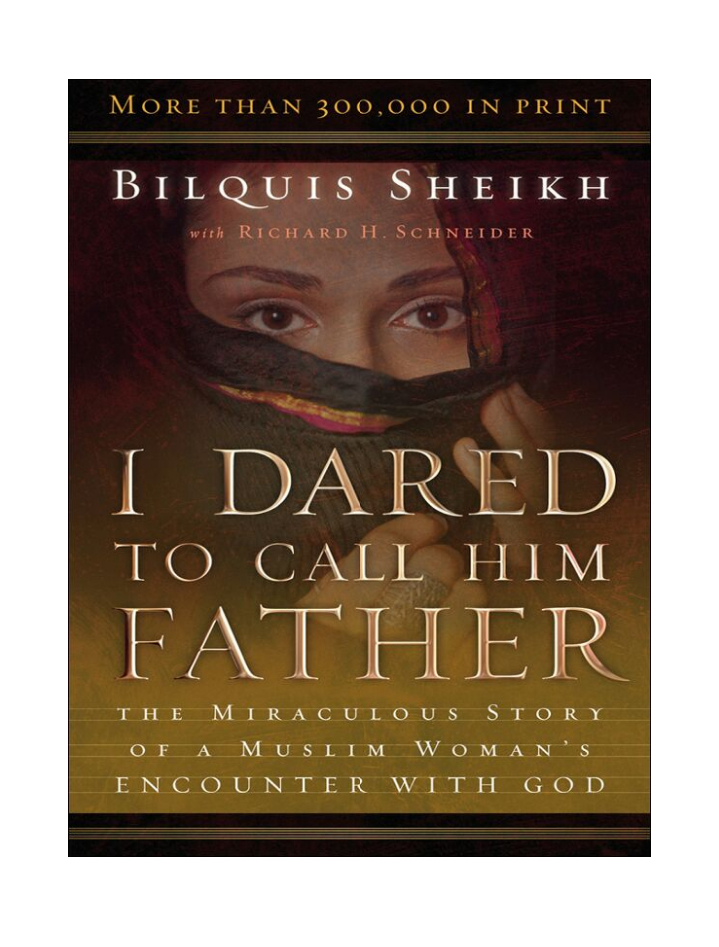
        I read a book about a Muslim woman in Pakistan, I Dared to Call Him Father, by Bilquis Sheikh) who, through dreams and an inner voice, came to understand that she was to become a Christian. I don’t understand why she couldn’t have had Muhammad and Jesus too. Don’t Muslims accept the teachings of Jesus the way Christians accept the teachings of Moses? This book told of another formerly Muslim woman, who had accepted the Christian Faith and then had been murdered, most likely by her brother. No arrests were made. In a practice known as “honor killing,” a woman, who is judged by relatives to have brought shame on the family, is murdered by a close male relative such as a father, brother or husband, often with impunity. This is part of the culture in some parts of the world. One can imagine how intimidating that is for the girls and women living in such a culture. I read a book some time ago that discussed the situation for women in Jordan (Honor Lost: Love And Death In Modern Day Jordan, by Norma Khouri). It described the murder of a woman by her father for being in a relationship with a Catholic man. This regimentation of the lives of girls and women, enforced by murders rarely prosecuted, predates Muhammad and Islam. It is a pernicious cultural practice that is changing very slowly with the slowly increasing educational opportunities for girls.
        According to the book, I Dared to Call Him Father, there are many secret Christians in Pakistan, people who secretly accept the salvation of Christ, while maintaining the appearance of being Muslim. The author, Bilquis Sheikh, was completely open about her conversion to Christianity. She did receive criticism and shunning from some family members, even some threats, but she prayed and lived a life of faith. She left Pakistan for awhile, then returned for the last few years of her life.
        Honor killing takes place against people who change their religion, engage in promiscuous. or homosexual behavior, refuse an arranged marriage, seek divorce from even a violently abusive marriage, or became the victim of rape. Although it is a crime primarily against women and girls, being gay can get a man killed within the cultures that practice honor killing. A young man or boy may be coerced into killing his own sister.
        Honor killings happen all over the world, but particularly in Muslim, Hindu and Sikh communities. I read the article on honor killing in Wikipedia, which gives details by country. There are laws against murder everywhere, but honor as an excuse for murder is effective in many locales for the perpetrators to receive lenient sentences or even to avoid prosecution all together.
        I admire the courage Bilquis Sheikh, a woman from a well-to-do family in Pakistan, showed when she felt the call from God to change her religion, and did so openly, even in the climate of fear created by the honor killings in her midst. The story, I Dared to Call Him Father, opens in the 1960s when Bilquis was in her 50s. She had been divorced and was the caretaker of a young grandson.
        The Quran states that God (Allah) is not our father, that he does not beget. Muhammad was explaining that the figure of speech Jesus used to describe God was only that — a figure of speech. I do not feel that that negates it’s aptness as a figure of speech.
        Some day religious bigotry and bias will end. True spiritually is universal, I believe, and a bigoted religiosity is not even spiritual.

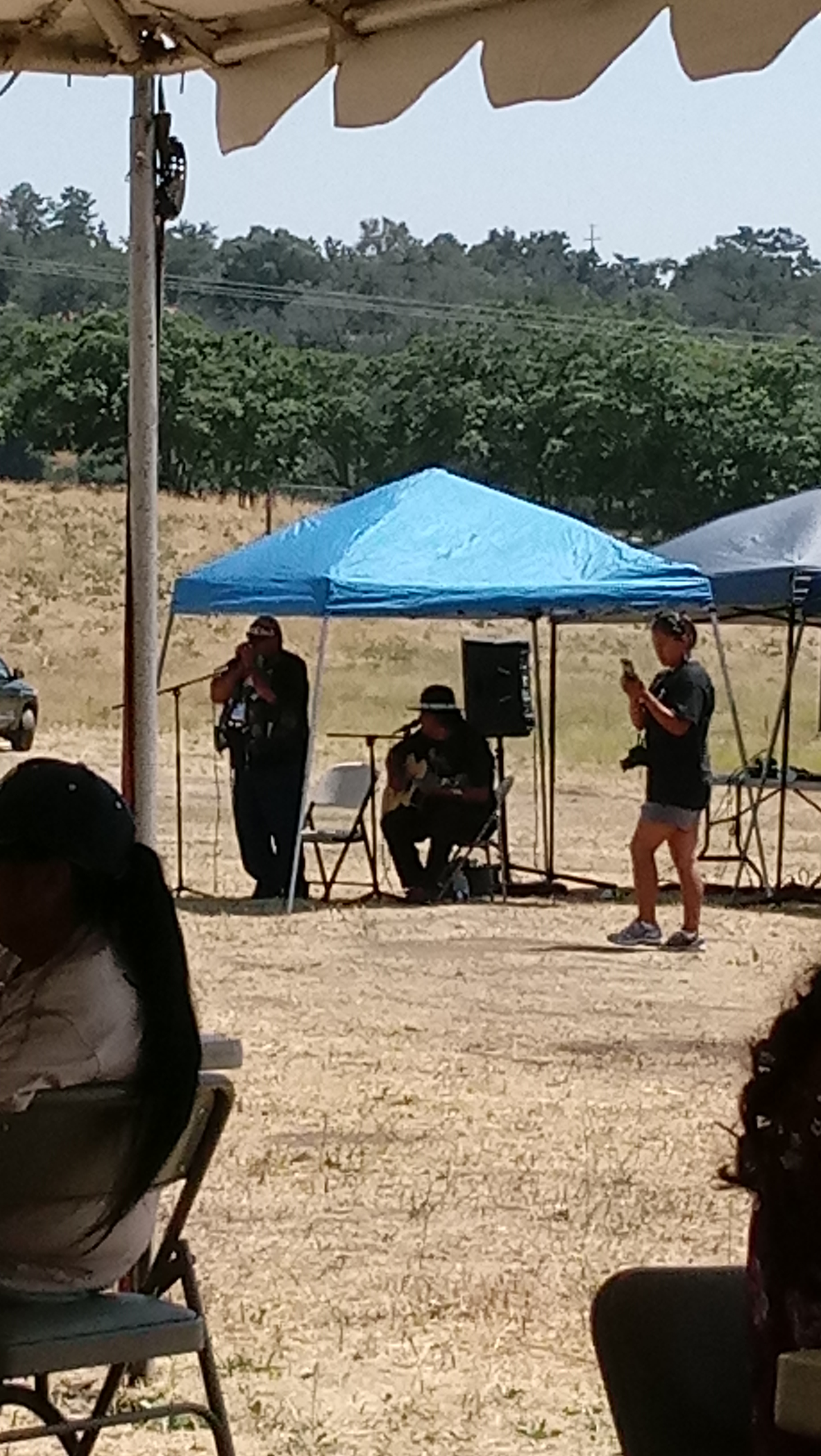
  •     I attended a tribal gathering this past Saturday with my husband in Mesa Grande, California. We were each given a large reusable shopping bag, a raffle ticket, a $7 food ticket and a tee shirt. The event was free. This worked out well with our empty pockets. No doubt the casino in Mesa Grande helps enable this generosity at the tribe’s annual gathering, which also included cash prizes for the winners of as assortment of games, including all-night Peon.
        Tracy Lee Nelson played the guitar and sang, but I couldn’t hear him very well. The outdoor PA system was not delivering, and to get closer would have meant standing in the hot sun. I liked where we were sitting under a large shade canopy with a nice breeze blowing toward our backs.
        The food we got was a piece of Indian fry bread with a generous scoop of beans, lettuce and tomato on top and a bottle of spring water. I ate the beans and salad off the top of my fry bread like it was a plate and was satisfied. My love ate all his food and then ate my fry bread too, and he didn’t feel well the next day. I felt great.
        My husband enjoys his cultural singing and dancing, known as Bird Singing and Bird Dancing. We both enjoy walking around the various booths and talking to the promoters of various products and information. But there really is a lot of sitting time in which I am glad to have an ebook on my phone. I was reading, My Promised Land, the Triumph and Tragedy of Israel by Ari Shavit.
        The natives of California have been colonized, exploited, abused and murdered for several centuries. 1848, the California gold rush, was a time of particular horror for them. In the brand new US state of California, settlers were actually paid to murder natives.
        One of the biggest years of horror for the Palestinians was 1948, 100 years later. At first the Jews settling Palestine bought land legally and got along with the natives, trading with them and hiring them in their businesses (which were, at that time, mostly agricultural, such as orange groves). Then Islamic terror struck in the form of the murders of Jewish civilians by displaced Palestinians or Arabs who sympathized with them. The Jews, severely traumatized by the recent holocaust in Europe, panicked. Innocent Palestinians were driven from their homes along with the guilty. Many more Palestinians died than did the settling Jews.;
        Over the nearly 170 years since the mostly white gold panners rushed California, the California natives have gradually been endowed with human rights. They no longer grace the cross-hairs of bounty-hunters’ rifles. They are allowed into public parks and museums. During the 1920s they received the right to vote.
        A generation or two after atrocities occur we whites really do want to make amends. We favored affirmative action to our own detriment because it was the right thing to do. In California and many other states, gambling casinos are illegal except on sovereign Indian land. This is a mixed blessing for the tribes. It is raising their standard of living, but very unevenly, and is also benefiting the tribes’ nontribal business partners perhaps even more. Casinos are full of slick, seductive machines designed to separate gamblers from their money. Casino income is the reason for tribal members being kicked off the rolls, so there is more of the money for those who remain on the tribal rolls, resulting in disappointment, hurt and sometimes litigation. Members of non-federally recognized tribes, such as the Tonva of the Los Angeles basin and the Ahashemen of Orange County, historically two of what were once the most populous tribes in Califirnia, were never granted tribal land, nor are they able to benefit from owning casinos. The claim was made that these tribes had gone extinct, they were all killed off. Many were, but many survived by disguising themselves as a different ethnicity or hiding in the hills. Still in an uneven, crude way, natives are benefiting from the casinos. They are helping to finance the cultural renewal that natives are experiencing. Native languages are being taught in tribal centers throughout the US and Canada. Basketry, archery, flute, rattle and drum making, tribal songs and dances are all making a comeback after generations of supression. Natives are no longer forced into boarding schools or forced to attend mass. They are free to learn what they like and worship as they see fit, but after generations of suppression they may not know a lot about the religion of their ancestors.
        Ari Shavit’s book dealt with the modern history of the Jews in Palestine, now called Israel. I admired the way Shavit seemed to sympathize with the plight of the Palestinians who suffered loss so that the Jews could have a country. Though his point of view seems more liberal than some, I didn’t like his emphasis on the supposed need of Jews to hang on to their culture. Does a people have the need for aspects of a culture that contain bigotry toward others? Does my culture, right or wrong, take precedence over someone else’s? Everyone should have a right to their culture, insofar as their culture is not a culture of murder, and Islam is probably at least as culpable as Judaism in that regard. The Christian culture has a murderous history as well. Perhaps it is time to leave that behind and root out aspects of all our cultures that are intolerant of others. The Jews may want to do that, but how can they do so without being themselves destroyed? That is probably the question asked by the book.
        Although I enjoyed the Shavit book, I did not enjoy learning that he may be a pervert in a web search on him I did after I had finished the book. He apparently sexually harrassed a beautiful, much younger, female reporter who met with him in order to interview him for the publication she works for. Then he resigned from his job because he was asked to, because other accusers had also come forward. I was disappointed that such a lucid, enjoyable writer as Ari Shavit appears to have such feet of clay.

  • Jesus in India

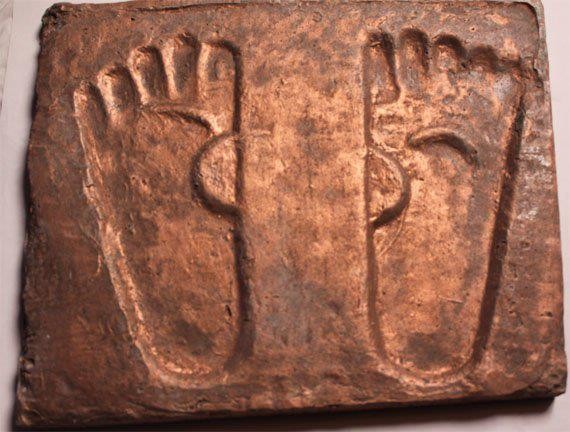
        I watched a fascinating documentary, Jesus Was a Buddhist Monk. The theme was that Jesus did not die on the cross. The film speculated on where he might have gone afterwards in order to avoid being captured and re-executed. It ended with Jesus having returned to the Kashmir providence of India which was represented a return to the place he had gone to in his youth between the ages of 12 to 29, a time frame was not covered in the history of Jesus’ life given in the Bible. The film showed the tomb of Jesus in Kashmir and his footprints showing the marks of the cross. Jesus adopted the name Yuz Asaf during his later decades when he lived as a wandering holy man in the environs of Kashmir.

        Intrigued by the film, I read two books for more information on the life of Jesus: The Unknown Life of Jesus Christ by Nicolas Notovich and Jesus Lived in India, his unknown life before and after the crucifixion, by Holger Kersten. The Notovich book was published in 1897, and the Kersten book was published in 1983. Also during my web research I discovered this related post on wordpress.
        The Notovich book introduces a manuscript kept in a Buddhist monastery in Kashmir. Unfortunately the manuscript had disappeared by the time Kersten retraced Notovich’s steps 100 years later, although he did find evidence to support its existence.
        The Notovich book did not contain the assertion that Jesus survived the crucifixion. The book describes the author’s exploration of India, Nepal and Tibet, in the late 1800s, by horse-drawn carriage and horseback. One of the members of his party was attacked and killed by a panther while they camped in a lonely place. Notovich heard about, and eventually tracked down, while recovering from a broken leg, written histories of and quotations from Issa, the Arabic name for Jesus. At last two volumes were brought, read and translated into Russian. Notovich wrote down the translations. They told the history of the Israelites, the birth of Jesus, his early interest in the word of God, his departure from his parents home around the age of 13, his travels through India, Nepal, Tibet his instructions there, and his preaching during that time, his return to Israel via Persia at about the age of 29, where the Notovich manuscript takes up the same history as the gospels, albeit refreshingly different.
        I love Jesus. When I was young I went to both Lutheran Sunday School and Seventh Day Adventist Sabbath School. They both took place in the same building. During that time I learned to pray and had one of my first mystical experiences at about the age of 7. Up until that time I had recurring nightmares where my tongue and hands felt thick and I experienced a terrifying feeling of bondage. The nightmares still occurred after that, but they were no longer terrifying, because now I knew what to do. I thought about Jesus and prayed to Him for help. I saw a purple form as he came to me. I felt energized in his love, comforted and in peace.
        Later on, my father stopped attending church and my mother, siblings and I attended the Methodist Church. She also took me to the Unitarian Church a few times, although it was a 30 minute drive away. The summer after I graduated from high school she took me to Unitarian Summer Camp for a week. I left home a year later and took a job where I worked Sundays, although I had wanted to fellowship with the Jesus People.
        Back to my young years, around the age of 10, thanks to rides there from a neighbor, I attended Sunday School 10 Sundays in a row at the Assembly of God Church, for which I was awarded my own red letter edition King James Bible. The more liberal churches I attended with my mother were using more modern translations, but I loved that Bible! I loved reading the words of Jesus set apart by the red ink. I read them over and over.
        It didn’t take very long to read everything Jesus ever said that had been recorded that I knew about. It can be done in less than an hour, and I usually read a good chunk of it every night before I went to sleep. Before long I knew all of Jesus’ words by heart.
        How wonderful to have an additional treasury of the precious words of Jesus included in The Unknown Life of Jesus Christ by Nicolas Notovich! Here is a small sample from Chsoter 7:

        5. But Issa [Jesus] then said: “The miracles of our God began when the universe was created; they occur each day, each instant; whosoever does not see them is deprived of one of the most beautiful gifts of life.” …
        13. And Issa also taught the pagans not to strive to see the Eternal Spirit with their own eyes, but to endeavor to feel it in their hearts, and, by a truly pure soul, to make themselves worthy of its favors.
        14. “Not only must you desist from offering human sacrifices,” said he, “but you must immolate no animal to which life has been given, for all things have been created for the benefit of man.”
        15. “Do not take what belongs to others, for it would be robbing your neighbor of the goods he has acquired by the sweat of his brow.”
        16. “Deceive no one, that you may not yourself be deceived; strive to justify yourself before the last judgment, for it will then be too late.”
        18. “Do not give yourself up to debauchery, for it is a violation of the laws of God.”
        19. “You shall attain supreme beatitude, not only by purifying yourself, but also by leading others into the path that shall permit them to regain primitive perfection.”

     
        The Notovich book created a furor among Christians. Some detractors traveled to the Hemis Monastery in northern India in order to destroy the original documents. As a result the abbotts there refused to show them or even to admit their existence.

        In 1922, after the furor had subsided, Swami Abhedananda, a disciple of Ramakrishna, having read the Notovich book, traveled to the monastery where he was shone the documents, and was assured that Notovich’s account of his visit there, and his rendering of the documents, were accurate.
        While not exalting him extravagantly, Buddhism seems willing enough to accept Jesus as one of its saints. Christian theologians, on the other hand, seem to want to draw a hedge around Christianity and create a schism between it and Buddhism. None need exist. The two religions are very similar. But this hedge drawing has been going on for nearly two millennia, which is probably why the material, discovered by Notovich, was left out of the Bible in the first place! Clergy tends to divide, emphasizing differences rather than commonality.
        I then read Jesus’s lived in India, his unknown life before and after the crucifixion by Hoger Kersten.
        The Kersten book discusses the Shroud of Turin extensively, giving convincing arguments for its authenticity. The shroud is like a detailed document of what Jesus experienced before and during the crucifixion. This meter and a half of linen in which Jesus was wrapped after the crucifixion bears the imprint of his visage. Perhaps the aloe and myrrh that his body was slathered in provided the pigment for the imprint of his face and body which became impregnated in the linen shroud. In any case, according to Kersten, some body heat would have been necessary. The little balls in the whip Jesus was whipped with left marks all over his body that were imprinted into the shroud. The crown of thorns was like a hood that left wounds all over his head, forehead and the sides of his face. The nail wounds were in the wrists, not the palms, and also behind the toes, in a little different place on each foot. The wound in his side from the sword was also visible in the shroud.
        What Kersten found remarkable was that Jesus was still bleeding when he was wrapped in the shroud. All his wounds were bleeding even one in his forehead from the crown of thorns, which had been removed before the herbs and shroud were applied and he was laid in the tomb. His head was raised, making the forehead the most elevated part of the body. That this wound continued to bleed would indicate a beating heart.
        Jesus respirations and heart rate had slowed down and were imperceptible, his body temperature had fallen. He was presumed dead. He may have been clinically dead for awhile and then recovered like one who has what is now known as a near death experience.
        We do know that, according to the gospels, Jesus left the tomb and appeared to many, not as a spirit or ghost, but as a man in the flesh, and there was no body left in the tomb.
        That he managed to escape a government intent on putting him to death was a miracle, and in that he must have been aided by the Essenes. They must have known intuitively that he needed rescuing from the sealed tomb, brought him a garment, and concealed him until he had recovered enough to make the trip to India.
        The Kersten book gives a background of Israelites being in Kashmir, making the case that the lost tribes ended up there after being dispersed. It was even hinted that Kashmir was the original promised land for the Israelites, rather than Palestine.
        According to the Qur’an, Jesus did not die on the cross, but it appeared that he did:

        And their saying: Surely we have killed the Messiah, Isa son of Marium, the apostle of Allah; and they did not kill him nor did they crucify him [to death], but it appeared to them so…, and most surely those who differ therein are only in doubt about it; they have no knowledge respecting it, but only follow conjecture, and they killed him not for sure”. Surah 4:157 M.H. Shakir

        Christian dogma often requires that a modern, scientifically literate human being suspend the rational thought process and accept unscientific points of dogma without question.

        Luke 6:39 King James Bible: And he spake a parable unto them, Can the blind lead the blind? shall they not both fall into the ditch?

        Jesus is saying, open your eyes! Don’t be led around blindly! Investigate for yourself! Don’t just take someone else’s word for it! I can believe in Jesus, the man of God, the holy one, the teacher of spiritual truths, even the perfect examplar, without burdening myself with unlikely mythology. Even of that, I can believe something miraculous if it is revealed to me personally. There is no reason to take on a burden of unscientific dogma. That is not what it means to be spiritual.

  • Flute Circle Cake

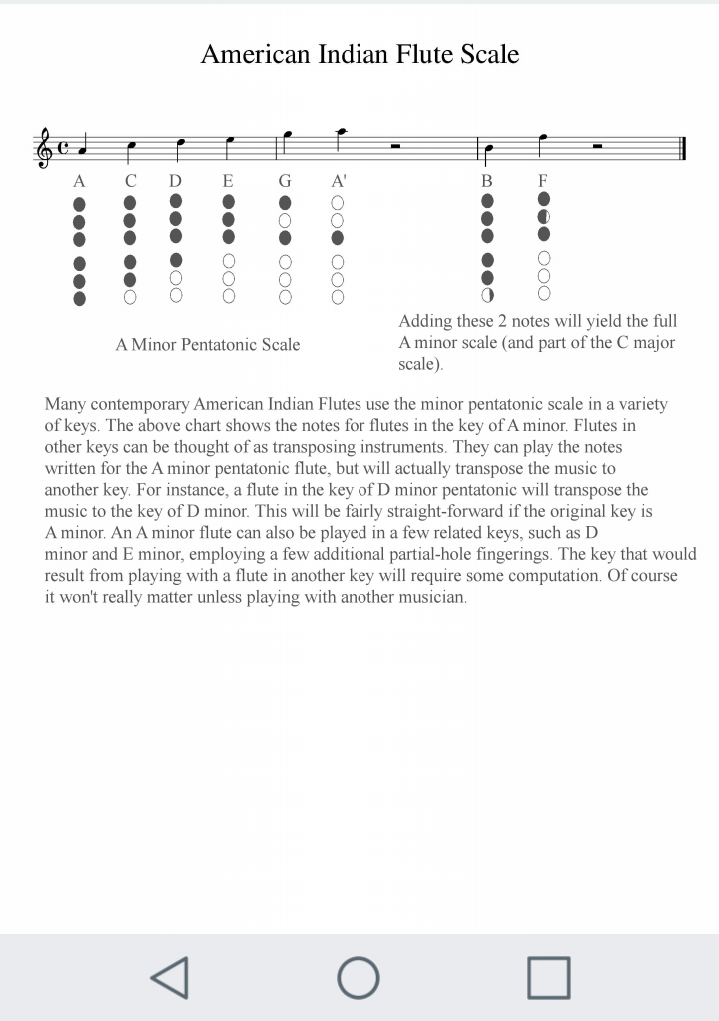
        The organizers of the Native American Flute Circle were celebrating five years of its existence. They meet on the afternoon of the third Sunday at San Luis Rey Restaurant and Bakery, where wonderful Mexican food is served free to the participants in the flute circle. Jim and I had salads with nopal cactus and beans. I forgot to request no cheese when I ordered our food, and it arrived with a light sprinkling of cheese which I scrapped off of mine. The restaurant is a great venue for recovery events as the food is excellent, the pastries are popular (although they don’t meet my standards), and no alcohol is served.
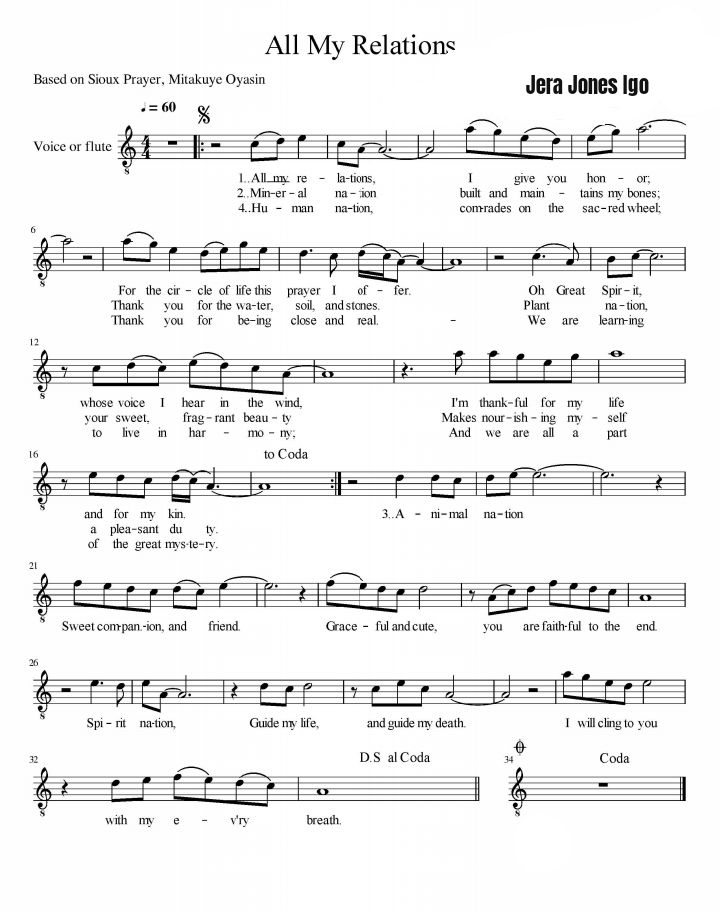
        I had brought a song sheet with a composition I had composed and written out called, All My Relations, inspired by the Sioux Prayer. I brought it up to the front encased in a clear zip lock bag. At the last flute circle the previous month, I had won a pair of silver and turquoise earrings in the raffle. I had asked myself, how can I contribute? I don’t seem do crafts anymore, but I still compose music.

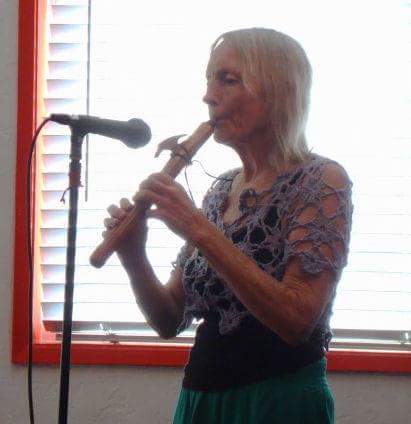
    Me playing my American Indian Flute at the flute circle

        A husband and wife team, Rob and Marge, have been doing an excellent job of keeping the flute circle going for five years. They both lead White Bison Wellbriety Recovery groups as well. When I made my offering for the raffle, Rob and pointed to something brown on a platter saying, “Look at our five-year cake!” I tried to keep my expression pleasant and not reveal my deep aversion for cake. I probably didn’t quite succeed.
        I love recovery people! They are not going to put liquor or dope in your face, and of that I am deeply grateful. But cake? How sad to switch one addiction for another.
        I got seduced into eating cake for the last time twenty something years ago. I was hanging out with a mother and daughter from Romania, I think it was. They were really sweet people. I was telling them a little about the religion I had recently discovered, the Baha’i Faith. They made an elaborately decorated cake and urged me to have a piece. I had cleaned up my diet quite a bit and was fairly sensitive to some of the ingredients in cake, such as wheat and sugar, but I didn’t want to be viewed as a food snob.
        Oh did I get sick! I spent several miserable days in bed. I never get sick unless I eat something that has been refined, adulterated, or sourced from a factory farmed animal. I had already known that, and I learned it again. But that was the last time for me for cake, unless I have reason to believe it was whole foods and vegan — or the dairy component was grass-fed and humanely cared for.
        The cake was cut and practically everyone in the restaurant had a piece. Even my husband accepted a piece and stirred it up with his fork but didn’t eat it. A woman later told me she regretted missing out when she had gone out temporarily during the time the cake was cut.
        My song sheet was the last raffle gift chosen. Why would a person want to struggle to learn to read and play composed notes when you can improvise something just as good or better?

  •     I wake up, think of my home and the relaxed way my spirit feels to belong there. I remember the horrible heist of my property and I recoil. I want this crime witnessed, and there You are in Your chariot and there I am beside You. Your arm is around my shoulder pulling me close to you. We are hovering in mid air where the roof of the house would have been had we not been occupying the space it would have occupied.
        There is Alex. I am learning Your thoughts. You look to see what glimmer of soul, what virtue, what spark of spirit there is in him, ignoring the dross. The way he is animated by new technology, before the pride comes thinking he is better and can do it better than others. There is the desire to be a nice person, before it turns into merely appearing to be a nice person with the attendent necessity of slandering others.
        There is Toni. When she considers the sorrow of her sister, she has a moment of empathy, before the excuses start coming, and she finds ways to distract herself. There is a nobility of soul, and the struggle of pride.
        I know that we are noble in ourselves, but not in the exclusion of others. I think people that exclude will be excluded. “Yes,” my Lord says with a twinkle in His eye, “See that you don’t exclude others.”

  •     This. morning I realized that there is a difference between having an opinion and making a judgment. If I have an opinion, I am still willing to talk to you about your opinion, even if it’s different from mine. Once I’ve made a judgment, I’m no longer open to discussion about differing opinions. I’m right, and, If you don’t agree with me, you’re wrong.
        Now I understand why the holy books say, “Don’t judge.” Obviously we can still have an opinion. When other people become judgmental we might feel emotionally battered. They are trying to take away our right to have an opinion that is different from theirs.

  •     At my mother’s memorial Dimas was wearing a fancy blue shirt that reminded me of a mariachi band uniform. As my mother’s friends and relatives were gathering, in what used to be my parents’ lake picnic area, for the service, Dimas seemed to be following me trying to get my attention. I walked the other way trying to ignore him.
        There had been a lot of prayer and meditation on my part in which I had surrounded Dimas with holy witnesses to observe what he had done. I had prayed and meditated in this way in order to heal people close to me who had been hurt by him, and in order to dissipate my own anger.
        It was no use, in the small crowd there was no way I could avoid him. My anger melted away when our eyes met. I had the feeling that he had confessed his sins directly to God and been cleansed. We were like two friends who had known each other for a long time, like two actors, one the villain, who shake hands once the play is over.

  •     I read, Filthy Rich, a biography of Jeffrey Epstein, checked out from the public library with the OverDrive app on my Android phone. It was hard to put down, and I wizzed right through it. The book was about a rich person who seemed above the law in the expression of his pedophile proclivity. James Patterson, John Connolly and Tim Malloy were the writing team.
        The book starts out with the story of Mary, a sixteen-year-old girl, who is lured by a friend of a friend to work for a rich neighbor, in Palm Beach, Florida, as a masseuse. With no experience in massage, she is promised $200 for showing up at the man’s mansion and providing a rubdown. Of course things escalate to more than she is comfortable with, and both girls get paid.
        Why it was such an interesting read, I don’t know. Perhaps I want to understand pedophilia and all its ramifications? Maybe I want to look at the sick so I can appreciate the healthy? Maybe I want to better understand some of the unpleasant encounters with inappropriate people I have had in my life?
         It was good to see an attempt at justice. The police chief did a really good job interviewing the victims and putting together the case, but Epstein’s legal team fought back effectively, and the sentence was reduced to less than 18 months with plenty of free time where he was allowed to leave the jail facility to go to his lawyer’s office and home and other places. It didn’t really seem like he got punished for what he did.
         A parasite on society in more ways than one, Epstein made his fortune helping billionaires find tax loopholes.