I like to write poetry, music, memoir, and allegorical fiction. I believe this life is for learning. I want to learn and teach all I can. * Email: jeraigo@yahoo.com *Facebook: https://m.facebook.com/jera.igo *BLOG: https://albinolizard.blog/ *Youtube: https://www.youtube.com/user/jerajones *Channel https://www.youtube.com/channel/UCFC4zVFFU4yCoEsR83nq2ZQ
It’s a new habit — well not really, I always knew that this was the right thing to do — but I often allowed my emotions to play in me. Love is not an emotion, it’s a decision. I knew that too.
What’s new is an insight I had recently about how to apply this specifically. I had been getting my feelings hurt about little things that, in the big picture, don’t really count. I had the amazing ability to stew about totally insignificant, even imagined, slights that, if written on a ledger along with the real gifts and blessings of my life (and a few major losses), were not even worth their own line.
Doing an about face and loving the people involved was the ticket to bliss. I mean, loving them in a state of meditation, sending love to people as they come to mind. Habits develop slowly, and I still have to remind myself fairly often. The meditative state can be achieved any time and anywhere. It is nice to have a quiet space and time to sit, but once the meditation habit is developed, the meditative state is always available. When I see someone in my mind’s eye, I can send them love.
I’ve been doing that more and more. I sent love to the attendant at the laundromat while she was in front of me physically. She turned around and gave me the sweetest smile. She had been wearing a mask for two years, and this time she was without it. But I think I’d recognize a smile, even with the mouth covered.
See somebody or think about somebody. Then see their spiritual essence. Then send love to the spiritual essence. The person will often respond in a loving way, if it’s an in-person contact. When it’s not an in-person contact, there will be a warmth when you do see them again.
I used to be quarrelsome. And I’d swear it was the other person being quarrelsome. I was aloof, but if you’d ask me, it was the other person being aloof. All my relationships have improved, but especially the one with the person I spend most of my time with, my husband.
We don’t fight over little things any more. I have a new way of handling insults, or what I used to perceive as insults, like people telling me what I should do, or someone comparing me unfavorably to themselves. Those things used to make me angry. I would get defensive and shriek my resistance. Now I just find something to be thankful for before I speak (or shriek). He’s kind of good looking, even when he seems to scold me the way my father used to do.
What a horrible habit I used to have of resenting people! What was I thinking? I was forgetting about the millions of things I have to be thankful for, and obsessing on one small detail that didn’t seem to go my way.
The escrow officer made an arithmetic error that cost me $366, and benefited the lien holder by that amount. My anger about that eclipsed my thankfulness for the windfall we had reaped in the deal as a whole, until I wrote out a ledger of what we had paid and what we had received. Now what do I do about the angry emails I’ve already sent? God doesn’t want me humiliating myself. I’ll just quietly repent for my lack of gratitude, and send love to the parties involved.
Amma
Amma is my role model. I saw her once, in 2004. I drove to someplace, in the Los Angeles area, where she was appearing. The venu, it may have been a church, was packed with people. I had lost my home and was hurting. She hugged the people one at a time. When my turn came she held me in her arms and on her lap like a baby. She spoke tenderly to me, telling me I was loved. I could access that moment again and again, even after it was over, and did so many times. The home was restored, temporarily, a few years later. Then in 2015 it was taken away again, right before my mother died of Alzheimer’s.
But the experience of being in Amma’s arms stayed with me, growing within, until I too have become a love ministry.
There are those who have not yet had a spiritual awakening. They will not be as receptive to an energetic blessing as those who are spiritually awakened. We bless them with the intention that their spirits open to the Divine will. This may be problematic for them and they may resent it. But this is what I would want were I spiritually dormant. I would want to be awakened. Even if I didn’t understand why my world was being turned upside down at first, I would want spiritual awakening. So this is absolute obedience to the golden rule of Christ, “Do unto others as you would have them do unto you.”
Twelve step sobriety is consistent with Baha’u’llah’s command concerning the nonuse of inebriating substances.
Alcohol
Become ye intoxicated with the wine of the of God, and not with that which deadeneth your minds, O ye that adore Him! Verily, it hath been forbidden unto every believer, whether man or woman.
(Bahá’u’lláh, cited in “The Advent of Divine Justice”, p. 33)
The drinking of wine is, according to the text of the Most Holy Book, forbidden; for it is the cause of chronic diseases, weakeneth the nerves, and consumeth the mind.
(‘Abdu’l-Bahá, cited in “The Advent of Divine Justice”, p. 33)
Drugs
As to opium, it is foul and accursed. God protect us from the punishment He inflicteth on the user. According to the explicit Text of the Most Holy Book, it is forbidden, and its use is utterly condemned. Reason showeth that smoking opium is a kind of insanity, and experience attesteth that the user is completely cut off from the human kingdom. May God protect all against the perpetration of an act so hideous as this, an act which layeth in ruins the very foundation of what it is to be human, and which causeth the user to be dispossessed for ever and ever. For opium fasteneth on the soul, so that the user’s conscience dieth, his mind is blotted away, his perceptions are eroded. It turneth the living into the dead. It quencheth the natural heat. No greater harm can be conceived than that which opium inflicteth. Fortunate are they who never even speak the name of it; then think how wretched is the user.
(“Selections from the Writings of ‘Abdu’l-Bahá” [rev. ed.], (Haifa: Bahá’í World Centre, 1982), pp. 148–49)
Regarding ḥashísh, you had pointed out that some Persians have become habituated to its use. Gracious God! This is the worst of all intoxicants, and its prohibition is explicitly revealed. Its use causeth the disintegration of thought and the complete torpor of the soul. How could anyone seek this fruit of the infernal tree, and by partaking of it, be led to exemplify the qualities of a monster? How could one use this forbidden drug, and thus deprive himself of the blessings of the All-Merciful?
Alcohol consumeth the mind and causeth man to commit acts of absurdity, but … this wicked ḥashísh extinguisheth the mind, freezeth the spirit, petrifieth the soul, wasteth the body and leaveth man frustrated and lost.
(‘Abdu’l-Bahá, from a Tablet—translated from the Persian)
Concerning the so-called “spiritual” virtues of the hallucinogens, … spiritual stimulation should come from turning one’s heart to Bahá’u’lláh, and not through physical means such as drugs and agents. From the description given in your letter it appears that hallucinogenic agents are a form of intoxicant. As the friends, including the youth, are required strictly to abstain from all forms of intoxicants, and are further expected conscientiously to obey the civil law of their country, it is obvious that they should refrain from using these drugs.
A very great responsibility for the future peace and well-being of the world is borne by the youth of today. Let the Bahá’í youth by the power of the Cause they espouse be the shining example for their companions.
(From a letter dated 15 April 1965 written by the Universal House of Justice to a National Spiritual Assembly)
Bahá’ís should not use hallucinogenic agents, including LSD, peyote and similar substances, except when prescribed for medical treatment. Neither should they become involved in experiments with such substances.
(From a letter dated 11 January 1967 written by the Universal House of Justice to a National Spiritual Assembly) From the Baha’i Compilation, A Chaste and Holy Life
THE TWELVE STEPS OF ALCOHOLICS ANONYMOUS
1. We admitted we were powerless over alcohol—that our lives had become unmanageable.
2. Came to believe that a Power greater than ourselves could restore us to sanity.
3. Made a decision to turn our will and our lives over to the care of God as we understood Him.
4. Made a searching and fearless moral inventory of ourselves.
5. Admitted to God, to ourselves, and to another human being the exact nature of our wrongs.
6. Were entirely ready to have God remove all these defects of character.
7. Humbly asked Him to remove our shortcomings.
8. Made a list of all persons we had harmed, and became willing to make amends to them all.
9. Made direct amends to such people wherever possible, except when to do so would injure them or others.
10. Continued to take personal inventory and when we were wrong promptly admitted it.
11. Sought through prayer and meditation to improve our conscious contact with God as we understood Him, praying only for knowledge of His will for us and the power to carry that out.
12. Having had a spiritual awakening as the result of these steps, we tried to carry this message to alcoholics, and to practice these principles in all our affairs.
Copyright 1952, 1953, 1981 by Alcoholics Anonymous Publishing (now known as Alcoholics Anonymous World Services, Inc.) All rights reserved.
There is a lot of common ground between the Baha’i Faith and the 12 steps. And although there are some differences, I think the like-mindedness of our collective purpose can be obscured by focusing too much on the differences. That being stated, the one fundamental difference in philosophy should be pointed out.
Forgiveness Comes From God
When the sinner findeth himself wholly detached and freed from all save God, he should beg forgiveness and pardon from Him. Confession of sins and transgressions before human beings is not permissible, as it hath never been nor will ever be conducive to divine forgiveness. Moreover such confession before people results in one’s humiliation and abasement, and God—exalted be His glory—wisheth not the humiliation of His servants. Verily He is the Compassionate, the Merciful. The sinner should, between himself and God, implore mercy from the Ocean of mercy, beg forgiveness from the Heaven of generosity and say:
O God, my God! I implore Thee by the blood of Thy true lovers who were so enraptured by Thy sweet utterance that they hastened unto the Pinnacle of Glory, the site of the most glorious martyrdom, and I beseech Thee by the mysteries which lie enshrined in Thy knowledge and by the pearls that are treasured in the ocean of Thy bounty to grant forgiveness unto me and unto my father and my mother. Of those who show forth mercy, Thou art in truth the Most Merciful. No God is there but Thee, the Ever-Forgiving, the All-Bountiful.
O Lord! Thou seest this essence of sinfulness turning unto the ocean of Thy favor and this feeble one seeking the kingdom of Thy divine power and this poor creature inclining himself towards the daystar of Thy wealth. By Thy mercy and Thy grace, disappoint him not, O Lord, nor debar him from the revelations of Thy bounty in Thy days, nor cast him away from Thy door which Thou hast opened wide to all that dwell in Thy heaven and on Thine earth.
Alas! Alas! My sins have prevented me from approaching the Court of Thy holiness and my trespasses have caused me to stray far from the Tabernacle of Thy majesty. I have committed that which Thou didst forbid me to do and have put away what Thou didst order me to observe.
I pray Thee by Him Who is the sovereign Lord of Names to write down for me with the Pen of Thy bounty that which will enable me to draw nigh unto Thee and will purge me from my trespasses which have intervened between me and Thy forgiveness and Thy pardon.
Verily, Thou art the Potent, the Bountiful. No God is there but Thee, the Mighty, the Gracious.
Tablets of Bahá’u’lláh, The Ninth Glad-Tiding
I must confess that there were times when, not understanding the finer points, I failed to be candid to another person about my part in a problem, thinking that absolution in prayer was sufficient. Perhaps another soul was hurt by my aloofness. On the other hand, not having to wear mea culpa on my sleeve affirms the intrinsic nobility of my being. Before learning of the Bahá’í Revelation, I used to confess things that I had not even done, but imagined I had done. Reading Bahá’u’lláh’s commandment not to confess to human beings but to God alone was a turning point in my understanding. At that point, I was enabled to begin releasing myself from shame.
It can be embarrassing to hear graphic descriptions of past misdeeds that humiliate the speaker. Sometimes it is funny. As a person matures in sobriety, humiliating confessions no longer seem appropriate, but comedy that borders on self depreciation might be okay.
When you are happy you can’t be angry. But you can have a sense of humor. Laughter and happiness are very compatible. When you’re happy there is no room for self pity. You can introspect, but you do it with confidence and hope. You are not afraid when you are happy. You can face danger, and you know that, no matter what the outcome, you will maintain your connection to Spirit. You can’t be happy and hate. There is no room in my heart for prejudice. You can’t be arrogant, or think too highly of yourself, and still be happy. You can’t be ashamed, or think too little of yourself, and still be happy.
I felt shame trying to capture me, and I resisted it. No! I have learned this lesson, I thought. I will be happy! I won’t fall under the spell of shame. There is nothing wrong with me! If I’m not perfect, I don’t have to be perfect! It’s enough to be authentic and honest.
I felt anger trying to capture me and I resisted. Ha-ha, it’s just a joke, let me laugh. Let me see the lips of Spirit smiling. Ah yes, I can drink the joy and escape the anger.
I felt the complainer try to capture me and I resisted. Sure I can whine — there’s always something — but why should I? There’s also always something to be thankful for. I can be grateful!
I felt fear try to grip me and I resisted. There is danger all around. Living is a dangerous activity. But will I let fear rule me, constrict me, isolate me? No way! Fully knowing the danger, I will be bold! Not foolish, I will take certain sensible precautions, like pray for the will of Spirit, maintain a healthy diet and lifestyle, and find voices of Truth within the deluge of propaganda.
The independent investigation of truth is a principle that I value very highly. I remember scrutinizing a slightly older couple, when I was about 23 years old, who were testifying to me on a street corner, while vehicular traffic was blocked off for some event. They were trying to convince me to give my heart to Jesus. Hadn’t I already done that? Don’t they know? Do they worship the same Jesus I do? If so, couldn’t they tell I already belong to him? If not, who or what has trapped them in a veil of presumption and unawareness?
There are a few things about fundamentalist Christianity that I balk at. One of them is taking on a posture of submission on a street corner. Didn’t Jesus himself say, it is hypocritical to do your penance in public?
I knew then about the independent investigation of truth, even though I may not yet have heard the words spoken, nor seen them in writing. This brings me to a very important point. Your own intuition is a very important part of your investigation of, and understanding of reality. But don’t just take my word for it, What do you think? Can you understand your life, your purpose, and the world around you, with nothing more than eyesight, hearing, smell, taste, and touch?
In order to understand life, I need, smell, hearing, sight, touch, taste, intuition, thinking, someone to explain it, or the right book? Check all that apply. I found that I checked all the above, although somewhat reluctantly when I got to the last two, because I really want to avoid adopting someone else’s explanation. I want to develop my own. However, sometimes I can read or listen to someone else’s ideas and be inspired by them.
Of course that doesn’t always happen. Sometimes I can listen to someone, thank them for their time, turn and walk away, then blog, decades later, about how presumptuous and unaware they were.
Here’s another quiz: Which of the following people are (or were) sincere good-hearted human beings? No, nevermind, I can’t do that. I was going to name some prominent politicians and media stars. A better question is, who do you admire and why? Do you seamlessly adopt whatever that person says into your own thought process? And conversely, is there anyone for whom you categorically refute everything the person says?
A human tendency is to pick a side, as if life were a football game, cheer one team and boo the other. True independence requires more than that. But maybe not everyone wants independence. Perhaps others value the camaraderie of belonging to a political party, even though their allegiance to one segment of the population alienates the rest of us. My purpose in writing this essay is to troubleshoot independent thought, exploring what sets it apart from dogma.
Dogma is a set of ideas that are accepted unchallenged on the merits of the perceived station of its source. If I am to accept someone’s ideas unchallenged, I must first recognize the station of the person or entity promulgating the teaching. To recognize the station of the issuing agency requires investigation. If they are so high and holy that I can just take their word for it, they practically have to be God. For anyone else, every point they make has to be logical, proven, and stand up to scrutiny. And yes, I will also use my intuition. I will separate myself, go into meditation, and let the spirit lead me.
It has been an interesting ride for the past couple of years. What is truth? I have asked that question perhaps even more than usual. I looked up death statistics and was unable to find any change in the rate when factoring in population density. I noticed a lot of media repetition of what I was beginning to suspect was a false narrative. It began to appear that all the media had been co-opted by monied interests. In place of news, I heard a carefully scripted advertisement for pharmaceuticals, using words like, “safe,” and, “effective,” with no proof whatsoever, other than, “because I said so.” What? I’m supposed to trust you after you tried to kill us with opiates?
I noticed that politicians who are funded, in their campaigns, by the weapons industry, agree with me on this. However, on other issues, like peace and democracy, these same people definitely do not agree with me! I noticed that politicians, who pay lip service to issues of human rights and human welfare, disagree with me on this issue, even though, in the past, I had felt more drawn to them on issues relating to the environment and education. I formulated the theory that perhaps those particular politicians are kept in their places by the pharmaceutical and food industries. I began to see the world run by the petroleum industry, divided into two competing camps: petroleum-based weapons, versus petroleum-based farming and pharmacy. I began to suspect that both industry and government leaders are a consortium of psychopaths and psychopath enablers.
Some of them pretend to be sympathetic with desperate people from the south whose ancestral lands have been appropriated by big ag, and others don’t even pretend. But none of them do anything to address the cause of the problem. God help us find a way to fix this!
Today (Friday, August 13) I discovered tempo changes only change the first 50 bars. Bar 51 and beyond reverts back to the original tempo. This flaw makes the app unusable for my purposes. At least I was able to export my files as standard MIDI files.
I’ve been busy making backing tracks for my compositions. I had previously made a book of 60 songs that I’ve written. Now I’m making backing tracks for them. I have already made 47 out of the 60. This next one is number 48. I’m using Walk Band on a tablet to make bass and percussion tracks that are used for rehearsals and may also be used for recordings and performances, with my woodwinds player and husband, Jim Igo.
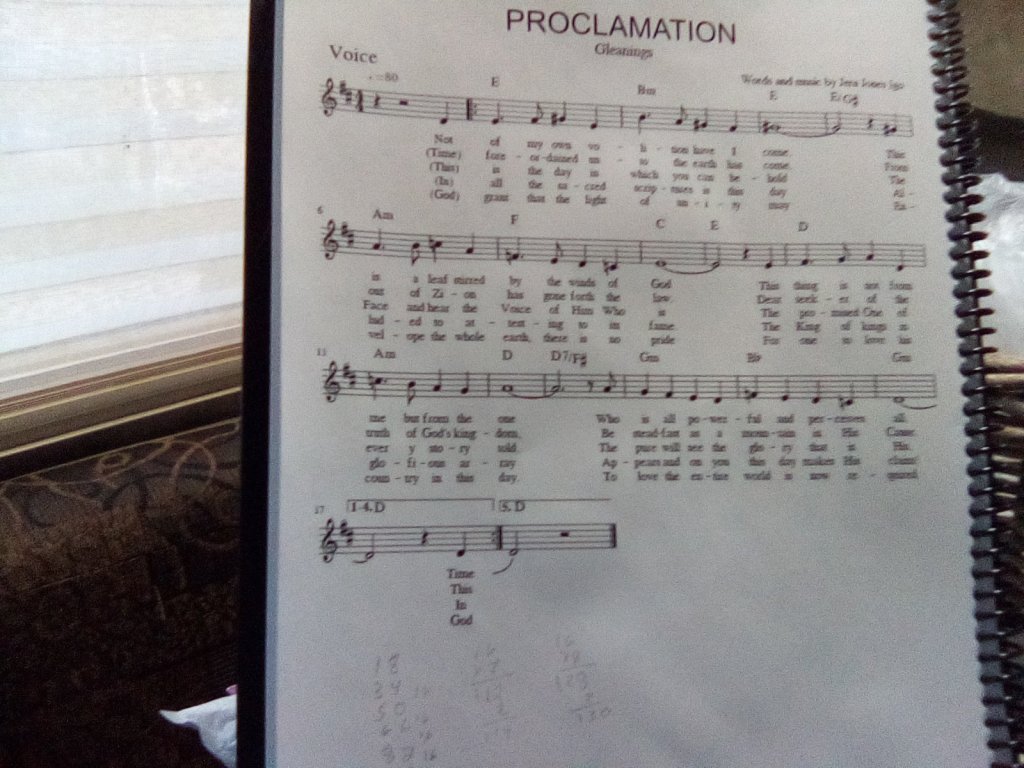
(The book is not for sale. I just made it for myself and band mates.) The song I am about to make a backing track for is called Proclamation.
The song is subtitled Gleanings because it contains some fragments from the Gleanings From the Writings of Bahá’u’lláh. It has 5 verses. I will use an instrumental verse for the intro and another for the outro, so my backing track will have 7 verses. I will describe my struggles with the backing tracks, using the current one as an example.
I started out using Musescore. I made the sheet music for my songbook with Musescore, and then I made a number of the backing tracks with Musescore as well. Then I exported the tracks as MIDI files, and played the MIDI files on my phone at our practice site at a nearby park. My phone ran out of memory, so I got a tablet, and used that, but I couldn’t find a program that would enable me to edit the MIDI files, make tempo changes and other small adjustments, except I did try Walk Band for that, but it changed the MIDI files to the point where it was frustrating. It changed the instrumentation around. It was pretty hard to predict what I would get, so I realized I would have to make the files on Walk Band if I was going to use that app to play them. It was quite a process of learning. I think the app is for playing an “instrument” such as “piano”, “guitar”, “bass” or “drumkit” on a phone or tablet instead of using the actual instrument. You could get 4 or 5 people together, each with a phone or tablet running Walk Band and have a “band”. That is not my purpose. I play a real guitar and Jim plays a real sax, flute or clarinet. I just need a recorded track of bass notes as a substitute for the bass player we don’t yet have, and ditto for percussion. It would be nice to be able to vary the tempo and the relative volume of the various tracks on the MIDI file. But I don’t want a bass to morph into a piano and vice versa.
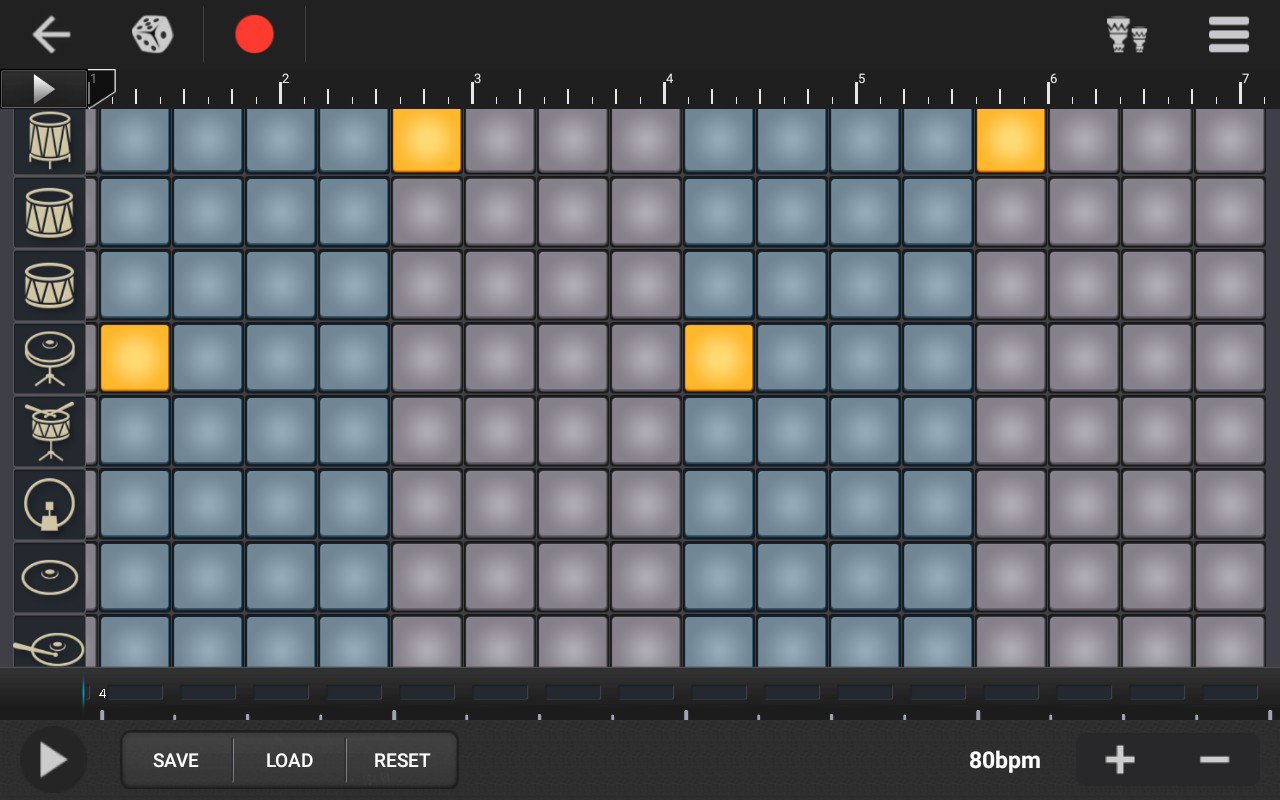
I downloaded several music apps to my tablet but Walk Band was the only one that I was able to get to record notes without a MIDI keyboard. Once I realized this is the way it is, I set about to learn the capabilities and limitations of the app. I tried the various ways of entering notes — and there are several. The way I find most useful is to touch squares on a grid. I power up the tablet and touch the Walk Walk Band icon to open the app.
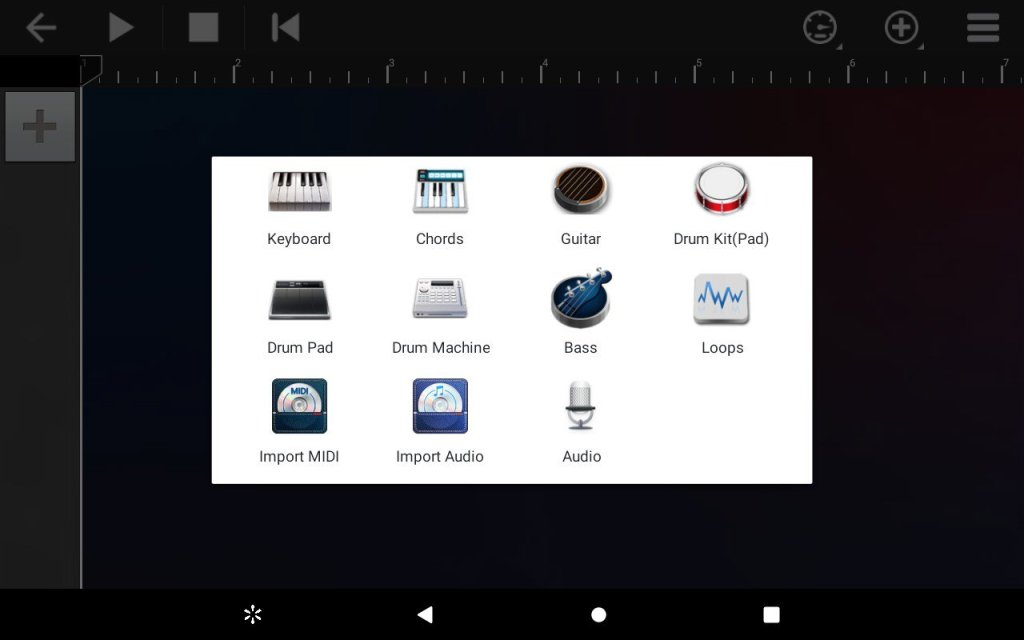
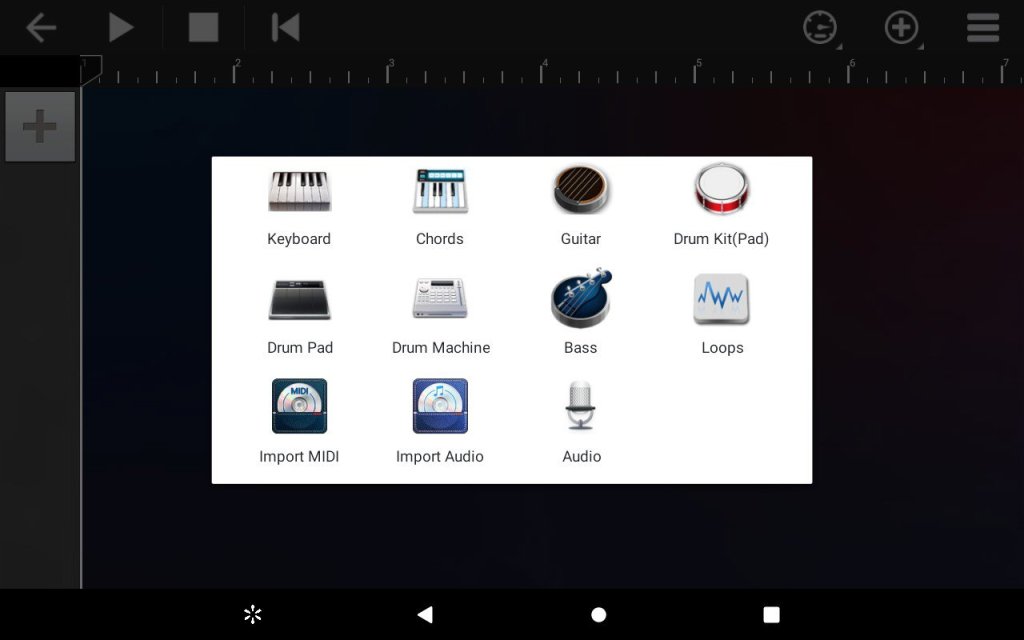
Icons for some of the instruments appear.
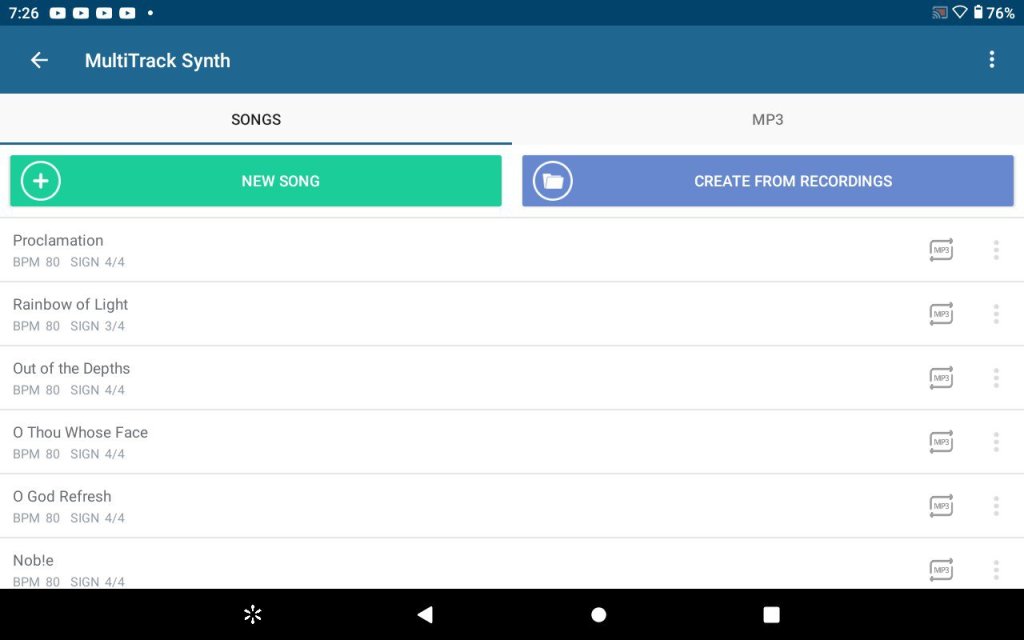
I choose Multitrack Synth.
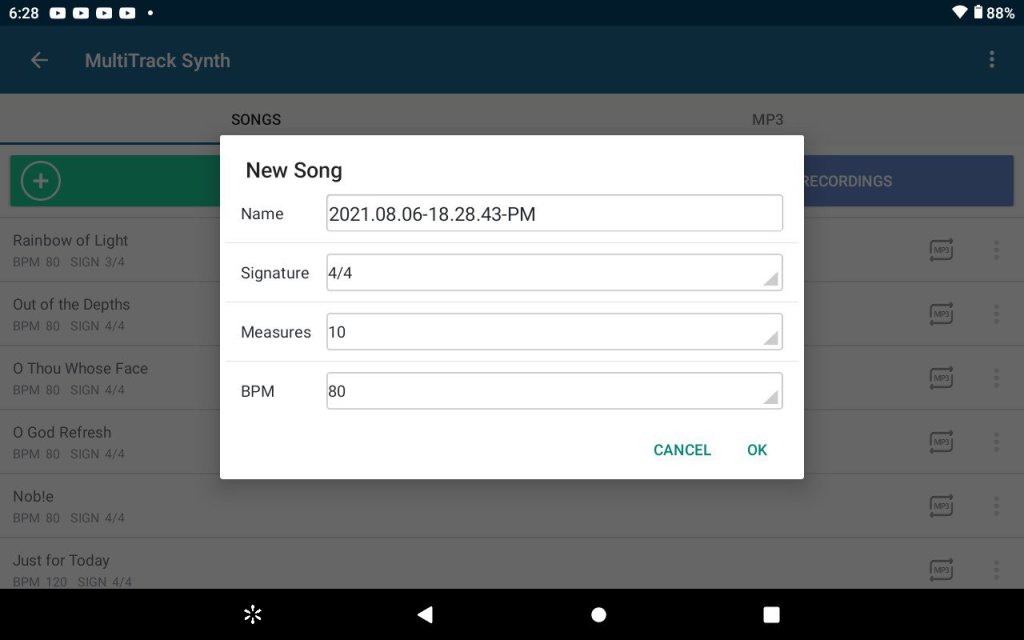
I get a list of music I have already developed, and the choice also of starting a new song, or creating from a recording. I am starting a new song so I select that option. A form pops up with fields for name, time signature and so on.
The name field defaults to a date and time. I want to name the file with the actual name of the song, so I touch next to the M of PM, a keyboard comes up. I hit the backspace to remove the date and time and type Proclamation. The time signature defaults to 4/4, which is what I want for this song, so I leave it alone. Measures (meaning number of measures) defaults to 10. I want many more than that. I touch inside the box, a drop down list appears with 10, 20, 30, 40 and 50. so I choose 50, which will probably not be enough, but I can add more later. At this point I must close the keyboard in order to look at the last field. I do this by touching the down pointing triangle at the bottom of the screen.
The last field is BPM (beats per minute – tempo). The default is 80, which happens to be what I want. But even if I wanted a different tempo, I would still choose 80, and I’ll tell you why. Because on another piece that I previously made a track for, using this app, I wanted a faster tempo, so I figured, I’ll just just go for 120 beats per minute. When I got to the end of the 50 bars that you can add at this point, and needed more measures, I had the opportunity to add more measures in the part of the program that opens next, and so I did, but assumed the default would be the tempo I had already set. So here I am checking out my great background which I thought I was all finished, and all of a sudden the temple slows to a crawl! What’s up with that? What was up with that was the new measures I had added were at 80 beats per minute and the original measures I had added from the beginning were at 120 beats per minute! It was a very unpleasant lesson because I had already done a lot of programming on the track, not realizing that the temple had gone awry. I couldn’t find a way to fix it other then to erase all the work I had done and start over! Now, no matter what tempo I want I let it stay at 80 for now, because once I’m finished recording the track, I can change the temple for the whole thing, but if I should forget that every time I add more bars I need to put in the temple I want specifically, not just accept a default, then it’s a real mess that cannot be fixed except by starting over.
I touch OK. I touch the + in the upper left corner of the next screen. I want to create a bass line, so I touch the bass icon.
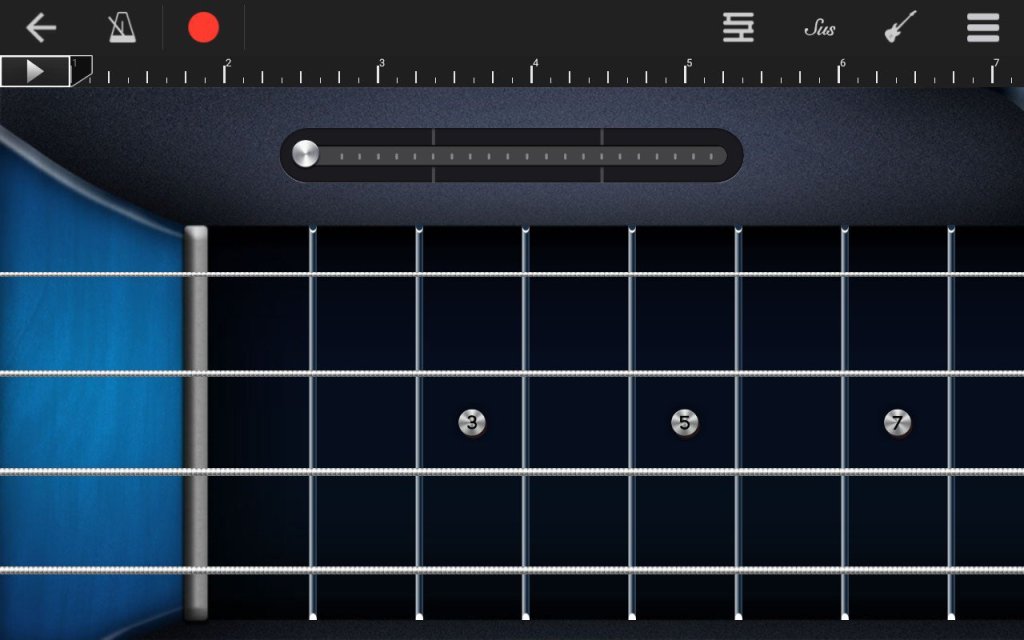
This next screen is a playable bass guitar game. I’m not much of a gamer, I just want to get to the next screen. If I push the back arrow, I’ll just get back to where I started. So I hit the red dot.
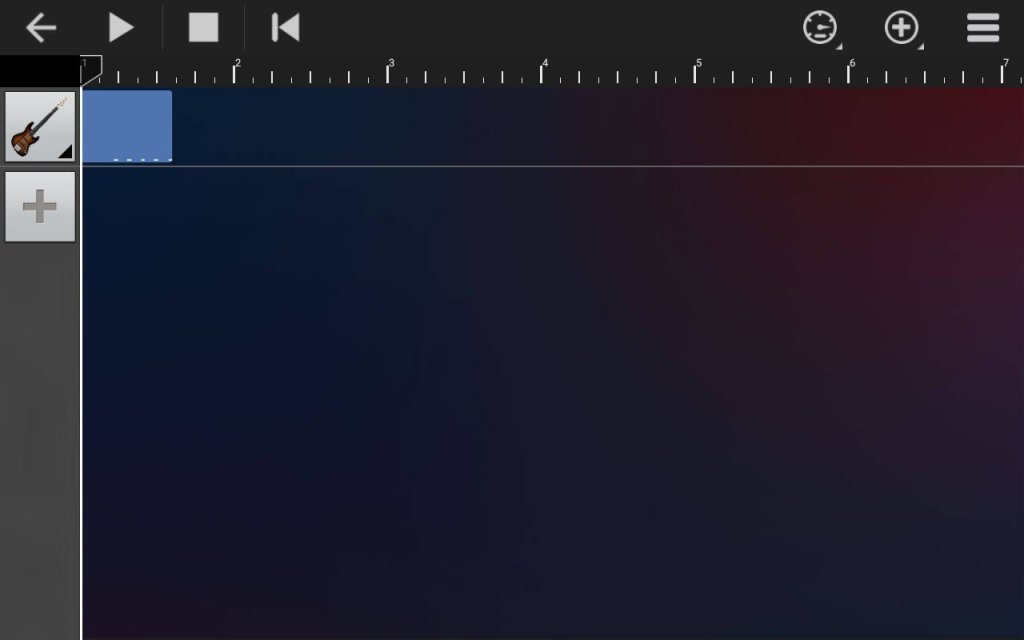
There are 3 clicks of a count-in while displaying the numbers, 3, 2, 1. As soon as that is over, I touch any string at any fret 2 or 3 times, then touch the stop button which is where the red dot used to be. Then I push the back arrow. The bass guitar icon is now on the left of the screen under the back arrow and above the +.
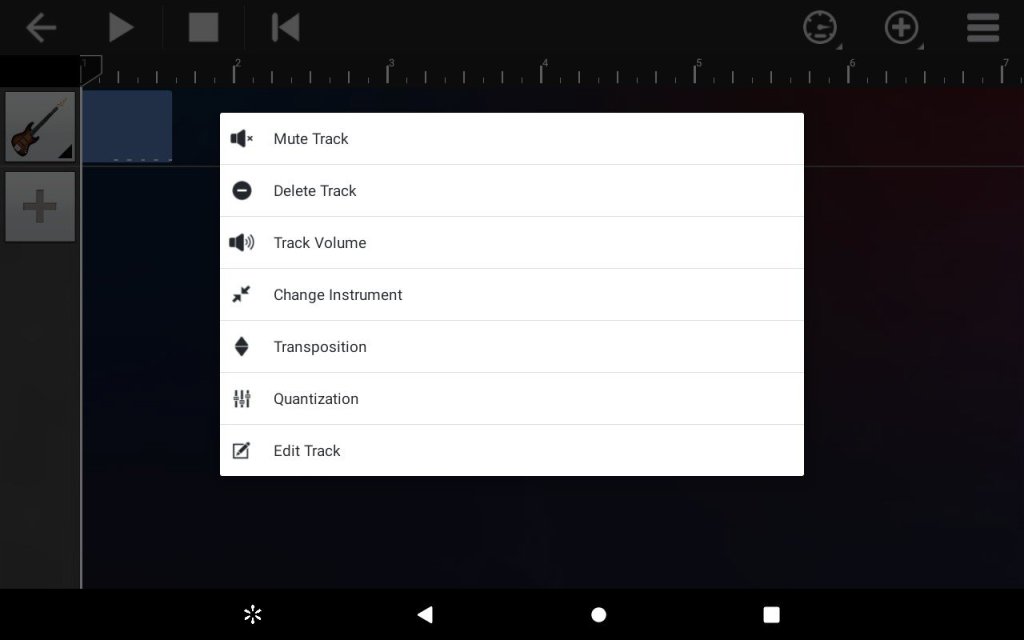
I touch the bass guitar icon. A menu opens up. I touch Edit Track.
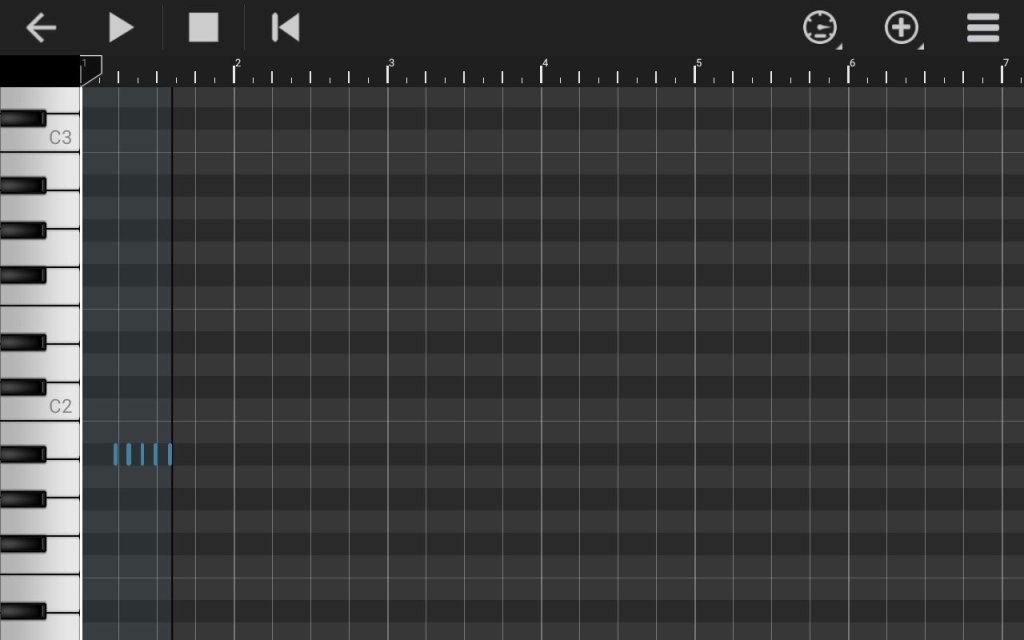
I scroll down to find the notes I entered near C2. I spread the screen apart with my fingers to make the notes bigger. I touch one of the blue boxes. Then I push delete. I continue deleting notes until they are all gone. Now I am ready to enter the notes I actually want. (If there is another way, other than this round-about way, to get here, I haven’t discovered it.)
I contract the screen again, keeping C2 visible on the left. I find the 3 at the top of the screen. I will start the bass part near this measure, reserving the first two bars for a count-in (and include the first bar of the score). I consider the style of the piece. If it were a blues or a shuffle, I would need to input 16th notes, then quantize them to triplet 8ths after I complete the inputting of the track. However, for this piece, regular 8th and 16th notes will be fine, if I decide to include any. I decide to use a quarter note on the first beat of every measure and another quarter note on the third beat of every measure. I could use a walking bass, but that might be too “busy” for this piece. The first beat bass note will be the root of the chord. The third beat bass note will be the 5th of the chord. The chord of the second measure (which will be the 3rd measure of this track) is E. The range of the bass guitar goes down to E1, but I decide to use E2 for this note. I touch the screen opposite E2 and just to the right of the line under the 3. Then I touch NEW on the menu that appears on the bottom of the screen. Since the next chord is a B (the 5th of E) I decide to use the 3rd of E for the note on the 3rd beat of measure 3. I touch the screen to the right of G#2 for the 3rd beat bass note of measure 3, then touch NEW.
Measure 4 of my bass track is going to correspond with measure 3 of my sheet music. The chord is Bm. I decide to use B1 for the 1st beat bass note. I push the screen to the left and input F#2 on the 3rd beat. I continue to input bass notes from the chords on the score. Each measure number on the score is 1 less than its corresponding measure number on the track… I have completed entering the first verse of the song, through measure 18 (which corresponds to bar 17 on the score). I push the back button. I want to save the file, so I push the back arrow again, and choose Ok on the menu that pops up. (Choosing Cancel would have erased everything I had done since my last save.) I now choose Proclamation to continue building the track.
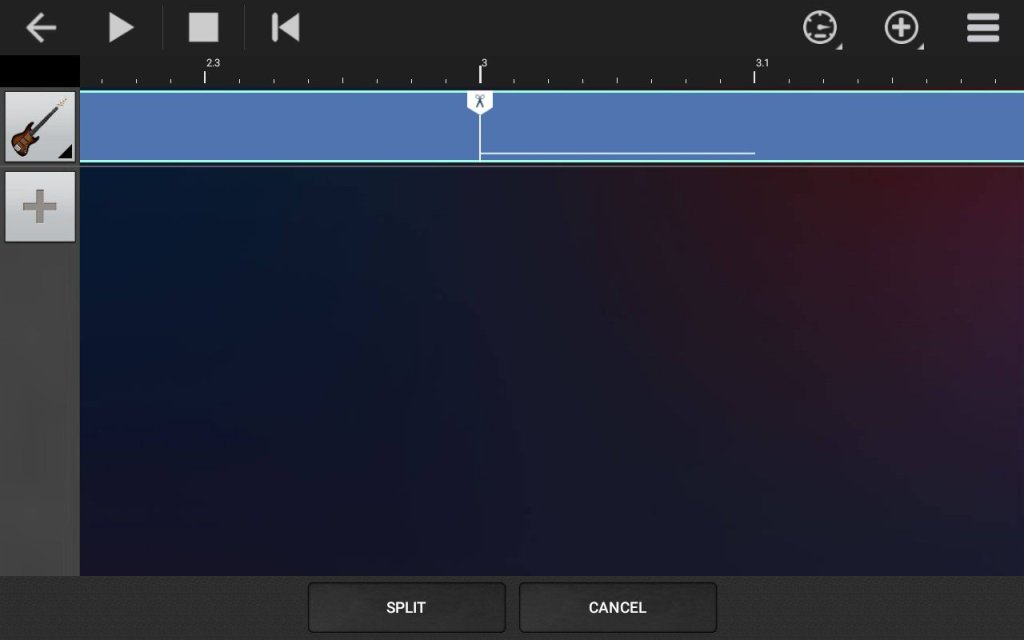
I must divide the beginning and the end of the first verse. I spread out the screen and position the 3 in the middle of the top of the screen. Then I touch the blue band under the 3. Then I touch SPLIT.
With a finger, I move the scissors handle directly under the line to the immediate left of the 3. Then I touch SPLIT a second time. Now I move the screen to the left to find measure 18.
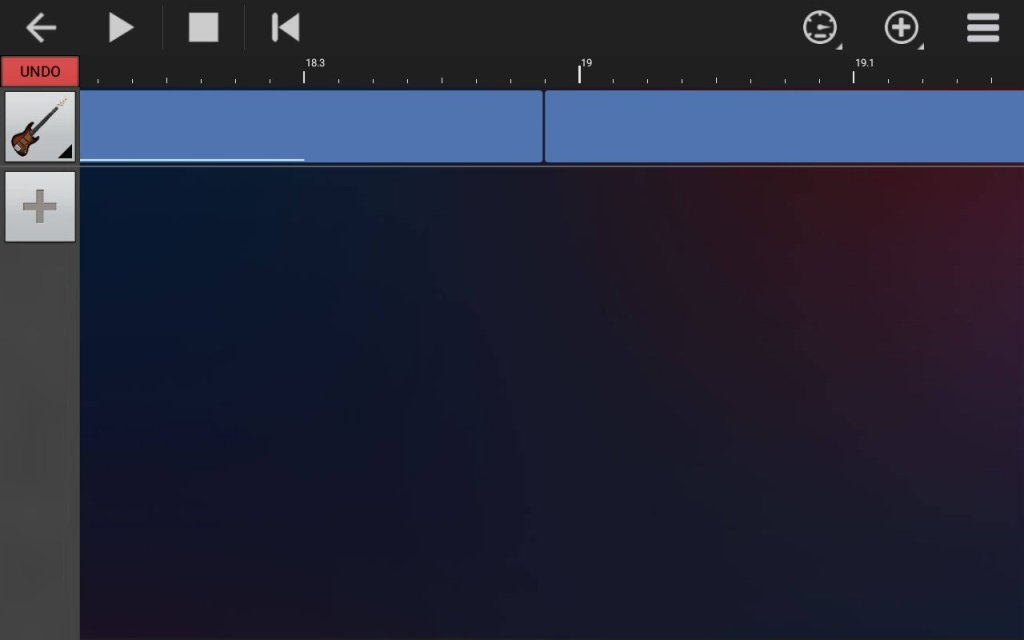
I touch the blue band somewhere between 18.3 and 19. There needs to be a gap between this split and the beginning of measure 19 or the verses won’t fit against each other. Then I touch SPLIT at the bottom of the screen, and touch SPLIT again. Now I touch the blue band to the right of the 19, and touch DELETE.
Now I touch near the end of the blue band, and touch DUPLICATE. The beginning of the white line needs to be under the line to the immediate left of the 19. If not, I touch the 2nd verse and then touch MOVE and with a finger move it into place. (If the first verse is too close to the 19, I have to split more off of the end of it, then select and delete the fragment.
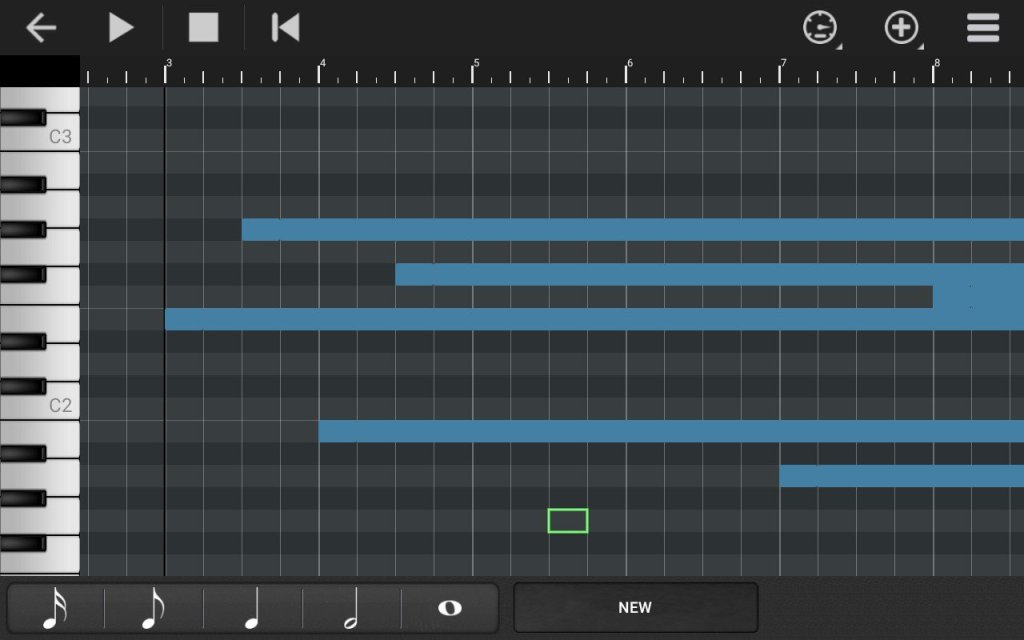
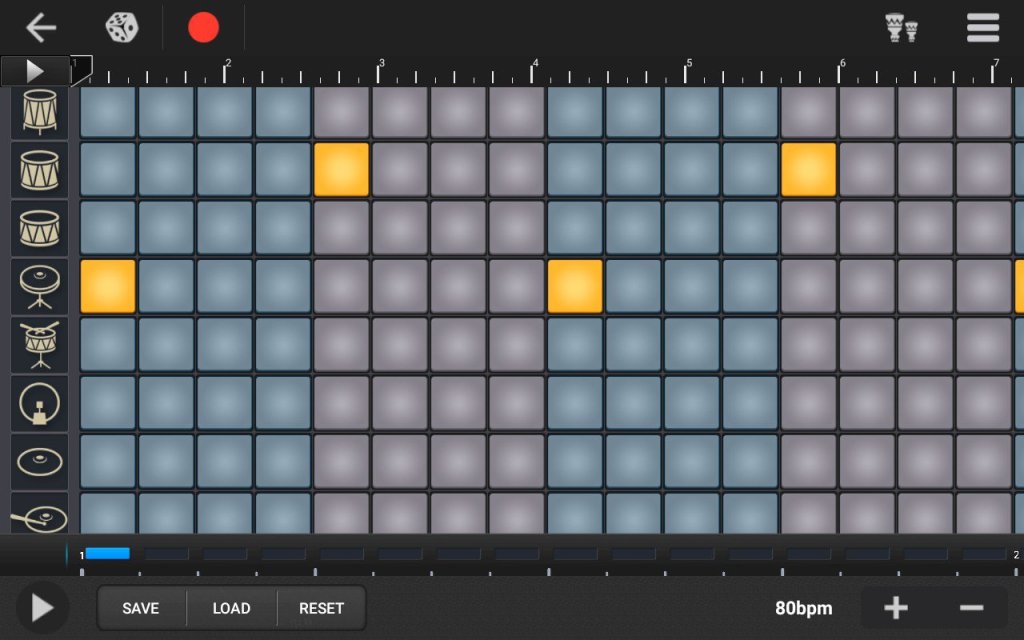
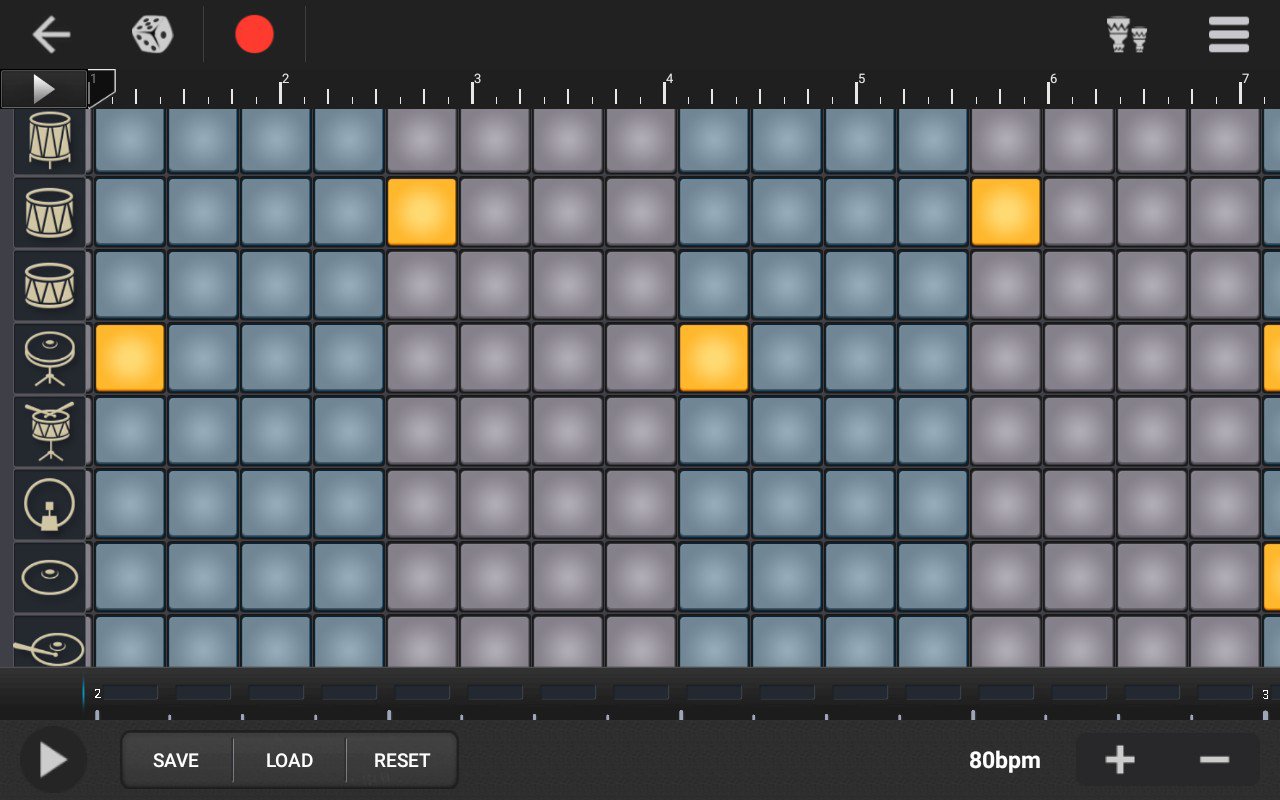
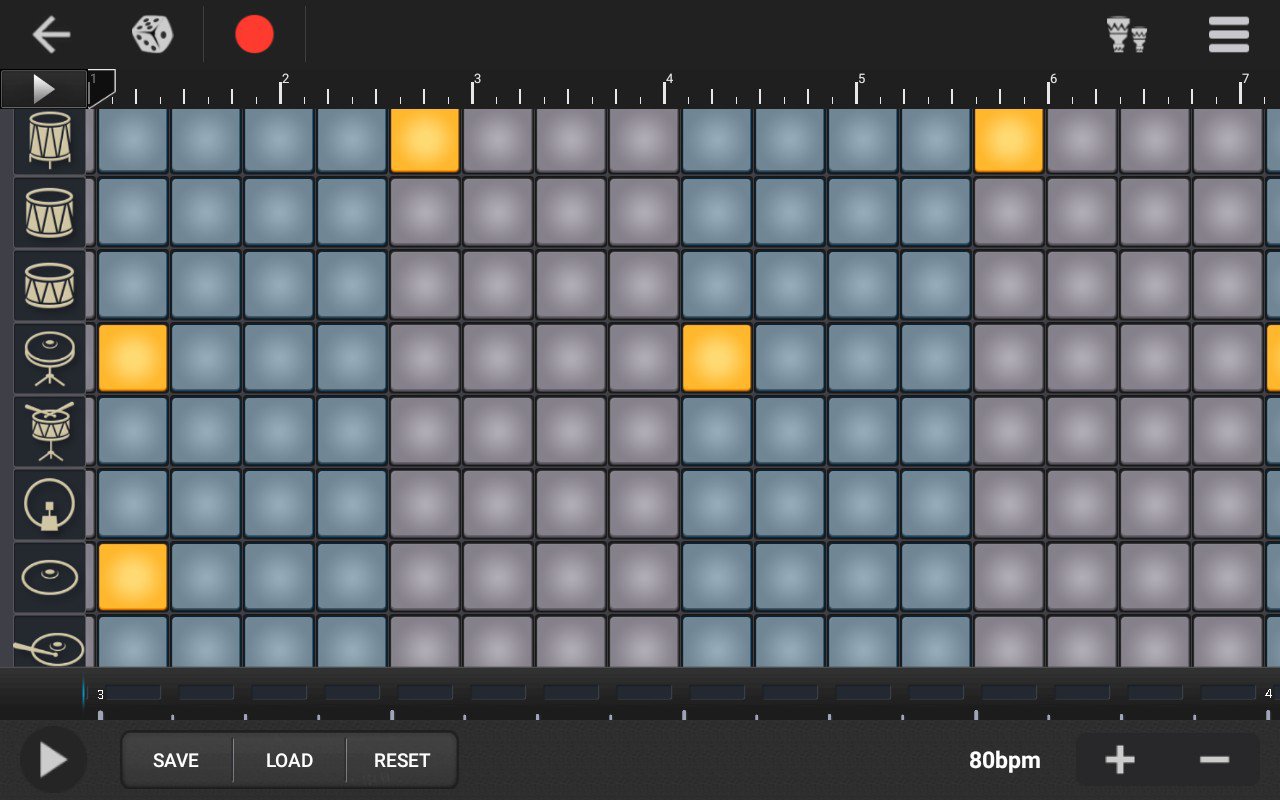
Touch the guitar icon and the Edit Track, scroll down to C3 or C2. If the notes are blurred together (like above), something is wrong. Push the back arrow and select and delete the second verse, then look at the edit screen again. Sometimes it’s not possible to line it up perfectly enough. I just continue adding verses until there are 7, lining them up as best I can. When I run out of measures, I touch the + in a circle on the top right. 7-16 bar verses plus a 2 bar count-in will require 114 measures. Add 50 then add 20. Touch the + on the left and choose Drum Machine to add a drum track.
Touch the red circle and record 114 bars. Now with my tablet, guitar, and a battery powered amplifier, I can play and perform this song anywhere!
When science becomes a prescribed opinion it isn’t science. Science is an independent investigation. An opinion that has been disseminated, is that the cold virus, current for the last two years almost, is capable of spreading from people who feel and appear healthy.
I have never experienced a virus that comes through me and gets other people sick without making me sick first. Is that a fact? But I’ve never seen it. Honestly, I don’t believe it. I want proof. That is something I have never ever seen. I have heard opinions to the contrary. I really think it is a matter of opinion, not of fact.
Is this what the Americans and Chinese were collaborating together on in the Wuhan lab? Is that what, “gain of function” is? Is it being able to spread through people who have no symptoms? Why are Americans collaborating with Chinese on bio weapons? There really are more questions than answers.
Without this dangerous property, mask wearing or vaccine taking for a variant on the common cold would make no more sense now than it ever has before.
70-75 years ago more babies were being born than had been normal up to that time. They called it the baby boom. This may be a factor in why there are more deaths now than had been normal up to this time. This is a mortal realm. We’re not here forever. Death happens. And no amount of distancing, masks or vaccines are going to stop it.
Can we make peace with our mortality? Yes, I am going to die at some point. All my friends and relatives are going to die at some point. Death can be postponed sometimes but not avoided completely. That being stated, I can avoid reckless behavior that makes an earlier death more likely. I can care for myself, and those I love in ways that will tend to prolong our lives.
Eating healthy food, drinking quality water, avoiding addictions, exercising frequently, getting fresh air and sunshine, having a positive outlook on life, making time for activities I love, staying connected to God and those I love are some of the ways I stay healthy.
Of course a long life isn’t everything, as people will quickly point out when I lecture them about dangerous vices. Quality of life is important too. I like not being sick. I like having a small body size. I like having the energy to do the things I love, like blogging and making music.
I don’t trust the pharmaceutical industry. They overcharge people. They suppress their own drugs once the patents expire. They suppress anything natural that can’t be patented. Anything that does have (or has ever had) a patent on it has been engineered somehow. I don’t want engineered substances in my body! I want unadulterated plants and natural water with natural minerals!
I don’t trust the advertising of the pharmaceutical industry. Okay a novel corona virus. What I see is the same amount of cold and flu there always is. Okay, remind me numerous times about the new cold virus every time I look at social media, email, the web, radio or TV. Without “Covid 19” popping up in my face numerous times per day every time I expose myself to the media, would I ever think about it? Not likely.
People I know get sick and die, but that always happens. No more now, no less. One friend of mine got sick right after getting his covid shot and died a few weeks later. They are calling it a cancer death, even though they never said anything about cancer while he was alive. I miss my friend. They are skewing the statistics imo.
No school, no church, no library, masks that reduce oxygen and increase carbon dioxide, social distancing and isolation have been going on now for six months! Who is benefiting from this? Who is sniggering at out discomfort while they rake in the dough—(or, perhaps, anticipate a profitable enterprise when a “cure” is brought to market, and forced on a captive public, liability-free)?
On the sequestration issue, my viewpoint is considered conservative. Normally, my viewpoint, on other issues–like health care and immigration–would be considered liberal. I don’t like top-down hierarchy. I like freedom, except for those who infringe on the freedom of others. Those particular individuals should be restrained.
There is a lot of missinformation flying around, some of it outright propaganda! (And censorship?) Deaths that would have happened in any case are blamed on a specific organism, and news outlets (that have corporate sponsors) greatly exaggerate the death toll associated with a particular organic signature. We always have deaths associated with colds, flu and pneumonia, what is different now?
Other than the mandates that have come down, I can’t see much difference between 2020 and other years. The overall death toll seems to be pretty normal. Any death is tragic, and yet, this is a mortal world. Death happens.
I want to go to the library where I can get my laptop online to write and upload this blog post, but I am learning the capabilities of my smart phone, to get the job done without wifi. Online meeting is amazing! I never would have tried it before. And while I would like to actually sit down and eat inside a restaurant, that won’t be a reality, so I might as well put something out in the solar oven.
In Tablet of the Maiden, Baha’u’llah described a mystical experience He had while suffering in prison. I became acquainted with the tablet when a friend showed me an excerpt from the writings of Baha’u’llah in the book, The Mystery of Sophia, by Robert Powell and Estelle Isaacson. After having studied the writings of Baha’u’llah and the Baha’i faith for over 20 years, I was surprised to find that there were English translations of His writings that I was unfamiliar with. I did a search, using a few of the words from the excerpt quoted in my friend’s book, and discovered the entire Tablet of the Maiden on a Baha’i library website,. I read it several times. It is a beautiful description of a mystical being, and of the mystical fellowship Baha’u’llah had with her during, what was otherwise, a grim and gloomy time.
The tablet describes an houri which I had never heard of before and probably misread the first time as “hour.” I looked it up and learned that an houri is an Islamic heavenly being. A promise in Islamic tradition is that houris will attend to the needs of. believers in paradise.
After reading and enjoying Baha’u’llah’s Tablet of the Maiden several times, I read the linked notes from the Universal House of Justice and the translator. I learned that the UHJ (the global governing body of the Baha’i Faith) did not fully approve of Juan Cole’s translation. They did not forbid the believer’s from perusing it, but they withheld full approval which would, if it were granted, have exalted this tablet to the status of scripture for Baha’is, along with the body of previously authenticated writings of Baha’u’llah, ‘Abdu’l-Baha, and the Bab, which, along with the Bible and the Koran, are scripture for Baha’is.
Only 5 percent of the writings of Baha’u’llah have been translated into English and authenticated by the Baha’i elected governing bodies. A few others, such as, the Cole translation of Tablet of the Maiden, are known as provisional translations, meaning they have not been authenticated by the Faith’s elected leaders.
Whether scripture or not, Tablet of the Maiden certainly belongs to a wide category of literature from which I derive inspiration and pleasure. One of the inspirations I am deriving from it is that the breast of God is accessible to me.
I believe the reason that the UHJ has not yet authenticated this work is that the English-speaking Baha’i community, as a whole, may not yet be ready for a glimpse of our Lord baring a woman’s breast. Perhaps not enough of us understand mystical allegory. Molesting a girl is horrible, but appropriating the nurturing potential of God is awesome!
There are several passages in the vast body of Baha’u’llah’s writings, which have been translated into English, and which have also been authenticated by the Guardian or the Supreme Body, in which Baha’u’llah refers to His contact with the Maid of Heaven.
In Epistle to the Son of Wolf, Baha’u’llah describes what He experienced while incarcerated in a brutal Tehran dungeon in 1852. Innocent of any crime, save that of being involved in the suppressed minority religion started by the Bab, Baha’u’llah was forced to trek, barefooted and bareheaded, before a jeering multitude pelting Him with stones, for several miles in the summer heat. Arriving at the dungeon, He was escorted down several long, narrow flights of steps to a damp, dark underground pit inhabited by killers, robbers and vermin. He was collared in a hundred pounds of chain. He sat on a low bench chained to other prisoners with His feet in stocks. The dark prison was gloomy and putrid. Other Babi prisoners were being summoned out to be tortured and killed.
There was little opportunity for sleep, and the weight of the chain was a constant torment. Yet, sometime near the midpoint of the four months during which He was in the black pit, Baha’u’llah had an amazing mystical experience which He later described.
In his Súriy-i-Haykal (Tablet of the Temple) Bahá’u’lláh describes his vision as follows:
“While engulfed in tribulations I heard a most wondrous, a most sweet voice, calling above My head. Turning My face, I beheld a Maiden — the embodiment of the remembrance of the name of My Lord — suspended in the air before Me. So rejoiced was she in her very soul that her countenance shone with the ornament of the good-pleasure of God, and her cheeks glowed with the brightness of the All-Merciful. Betwixt Earth and Heaven she was raising a call which captivated the hearts and minds of men. She was imparting to both My inward and outer being tidings which rejoiced My soul, and the souls of God’s honoured servants. Pointing with her finger unto My head, she addressed all who are in Heaven and all who are on Earth saying: ‘By God! This is the best beloved of the worlds, and yet ye comprehend not. This is the Beauty of God amongst you, and the power of His sovereignty within you, could ye but understand.’” [Bahá’u’lláh, Summons of the Lord of Hosts, page 5 (Tablet of the Temple comprises the first section of Summons of the Lord of Hosts). This passage is also quoted in God Passes By, by Shoghi Effendi, pages 101-102.]
After His release from the black pit of Tehran, His health broken, Baha’u’llah, His son, ‘Abdu’l-Baha (then 13), His daughter, Bahi’ih Kanun (then 12) and His pregnant wife were banished to Baghdad, across a snowy mountain pass, in winter. Two of His brothers also accompanied Him.
According to Shoghi Effendi’s histories of the Babi and Baha’i Faiths, Baha’u’llah wrote prolifically during the decade He spent in Bhagdad (1853-1863 including the two years He absented Himself to Kurdistan due to problems with a half brother). His literary works during that period include The Book of Certitude, which explains the Babi doctrine, later to become the Baha’i doctrine, of the Manifestation of God, Who appear from age to age, and include Krishna, Abraham, Zoroaster, Moses, Buddha, Jesus and Muhammad. The Bab, too, is a Manifestation of God, asserts Baha’u’llah, citing the proofs of His recently martyred contemporary. As a general concept the doctrine of the Manifestation of God is also taught in Hinduism as the return from age to age of the divine avatar. The writings of Edmund Bordeaux Szekely, who translated the Essene Gospels of Peace approximately a hundred years after Baha’u’llah’s Book of Certitude was written, frequently make mention of the great teacher to humanity, who arises periodically throughout history, and names some of the same Figures put forth by Baha’u’llah. Both Buddha and Christ promised to return, their followers expecting the Matreya and the second coming of Christ respectively. Jews still await the Messiah. One of the sects of Muhammad’s followers, the Shia, expect the return of the Twelfth Imam; the other sect, the Sunni, expect the appearance of the Mahdi.The appearance of a messianic figure was widely expected during the 19th century. America experienced revivals known as the great awakenings. Everywhere expectation was high.
Another book Baha’u’llah wrote during the Baghdad period was the mystical Seven Valleys, written in response to Sufis He met during His sojourn in Kurdistan. This book introduced the concept of the Friend, the personal companion we each have once we are awakened spiritually. Krishna spoke of the concept in the Bhagavad Gita. Gita 6:30, “He who sees Me in all things, and sees all things in Me, he never becomes separated from Me, nor do I become separated from him.”
Christians speak of having a relationship with Christ. Matthew 11:27-30: “All things have been committed to me by my Father. No one knows the Son except the Father, and no one knows the Father except the Son and those to whom the Son chooses to reveal him.
“Come to me, all you who are weary and burdened, and I will give you rest. Take my yoke upon you and learn from me, for I am gentle and humble in heart, and you will find rest for your souls. For my yoke is easy and my burden is light.”
In Baha’u’llah’s Seven Valleys, we deepen in our relationship to the Friend in seven phases, hence the seven valleys: the Valley of Search, the Valley of Love etc..
Baha’u’llah also wrote the poetic Hidden Words during his stay in Baghdad. He would walk along the banks of theTigris River and compose a verse or two, writing in either the Persian used in the Sufi poetry of His Iran heritage, or the Arabic used in the Koran and the oral and written traditions of the Prophet Muhammad.
“O SON OF SPIRIT! … Turn thy sight unto thyself, that thou mayest find Me standing within thee, mighty, powerful and self-subsisting.”
The themes of the individual revelations within the book are devotion, detachment mystical love, faith and so on. In fact they run the gamut of the themes found in divinely inspired writings, with the amplification factor of the recency of their revelation, being now around 150 years ago, by the Founder of the most recent world religion, the Baha’i Faith.
The idea of the god within is as old as the Brahmins and as new as the enlightenment of the most recently enlightened person. Yet the ignorant either call it blasphemy or take it as an excuse for presumption.
Baha’u’llah wrote many other works during the Baghdad period. When Baha’u’llah was about to be expelled to Constantinople in 1863, He wrote the Tablet of the Holy Mariner (pages 224-225, Baha’i Prayers), an except follows:
“Whereupon the maid of heaven looked out from her exalted chamber,
Glorified be my Lord, the All-Glorious!
And with her brow signed to the Celestial Concourse,
Glorified be my Lord, the All-Glorious!
Flooding with the light of her countenance the heaven and the earth,
Glorified be my Lord, the All-Glorious!
And as the radiance of her beauty shone upon the people of dust,
Glorified be my Lord, the All-Glorious!
All beings were shaken in their mortal graves.
Glorified be my Lord, the All-Glorious!
She then raised the call which no ear through all eternity hath ever heard,
Glorified be my Lord, the All-Glorious!
And thus proclaimed: ‘By the Lord! He whose heart hath not the fragrance of the love of the exalted and glorious Arabian Youth,
Glorified be my Lord, the All-Glorious!
‘Can in no wise ascend unto the glory of the highest heaven.’
Glorified be my Lord, the All-Glorious!”
Up to this point Baha’u’llah had not claimed a leadership role in the Babi community, although He was greatly respected by many of the Bab’s followers. Immediately prior to leaving for Constantinople, Baha’u’llah announced to his family and a few followers that He was the one who had been foretold by the Bab.
Baha’u’llah and the Bab were born two years apart, 1817 and 1819 respectively by the Gregorian calendar. Under the Islamic calendar, in use in Persia at the time, their birthdays fell on two consecutive days. However, translating their birthdates into the Gregorian calendar resulted in their being observed a month apart. Recently the western Baha’i world began to observe the birthdays of their twin manifestations on two consecutive days which vary from year to year, but generally fall sometime within October or November.
Prior to the births of Baha’u’llah and the Bab, Shaykh Ahmad, a Shi’i Moslem cleric born in 1753, taught a more scientifically harmonious approach to spirituality than the literalist interpretations that dominated. He taught that the journey Muhammad reportedly took to Jerusalem and back to Arabia within the duration of a single night was not a physical journey. Although this seems logical now it was controversial at the time. Shaykh Ahmad also prophesied the eminent coming of a new Manifestation of God. After Ahmad’s death in1826, the Shaykhi school came under the leadership of Siyyid Kasim. Siyyid Kasim became increasingly aware of the proximity of the coming of an new Manifestation of God. From Nabil’s Dawnbreakers: “To his disciples who questioned him regarding the signs of the Manifestation, Siyyid Kasim would say: ‘He is of noble lineage. He is a descendant of the Prophet of God, of the family of Háshim. He is young in age, and is possessed of innate knowledge. His learning is derived, not from the teachings of Shaykh Ahmad, but from God. My knowledge is but a drop compared with the immensity of His knowledge; my attainments a speck of dust in the face of the wonders of His grace and power. Nay, immeasurable is the difference. He is of medium height, abstains from smoking, and is of extreme devoutness and piety.’” He had even appeared unnoticed at one of the Siyyid’s lectures.
In 1843, when Siyyid Kasim passed away, his disciples dispersed to search for the Promised One. Mulla Husayn, who had distinguished himself in service to the Siyyid, traveled from Karbila in Iraq to Sharaz in the south of Iran, following his intuition. The evening before May 23, 1844, he met a young man who looked vaguely familiar. They struck up a conversation and the young man, Ali Muhammad, invited Mulla Husayn to his home. There the Bab revealed himself to Mulla Husayn. Siyyid ‘Ali-Muhammad, also known as the Bab (which means gate or door), was born 1 Muharram 1235 A.H., according to the Islamic calendar (20 October 1819 AD, according to the Gregorian calendar).
Over a millennium earlier, the martyrdom of another Husayn, Imam Husayn, grandson of the Prophet Muhammad (now known as the Bab or Gate), tragically occurred at the Battle of Karbala 10 Muharram 61 AH or October 10, 680 AD. This bitter day is still commemorated by Shias. As the Movement founded by the Bab grew, the joyous celebration, by the Babis, of the Bab’s birthday, and in time Baha’u’llah’s also, contrasted with the more somber commemorations of the martyrdom of Husayn still being being widely observed, in Iran, near the same days.
The Bab’s house in Shiraz with the upstairs room where the Bab declared His Station and Ministry to Mulla Husayn, in 1844, was demolished, in 1981, as part of a plan by the post-1979-revolution government of Iran to persecute the Bahai’s by, among other things, destroying their shrines. The persecutors built an Islamic religious building on the site, named “Bayt-al-Mahdi” or “The House of the Promised One”.
The Bab prophesied the eminent appearance of another Promised One, One greater than Himself Whom He referred to many times in His writings as Him Whom God would make manifest.
Mirza Husayn Ali Nuri, now known as Bahá’u’lláh (the Glory of God) was born on the second day of the Islamic month of Muharram, 1233 A.H. (12 November 1817), in Tehran, Iran. His son, ‘Abdu’l-Baha,Who later became the Center of the Covenant, was born the same night the Bab declared Himself to Mulla Husayn, May 23, 1844. Soon afterwards Baha’u’llah became involved in the Movement inaugurated by the Bab.
The Bab was imprisoned, first house arrest, then moved to mountain fortresses. Baha’u.llah convened a conference of Babis at Badesht, in the mountains near the Caspian Sea. There Tahirih, the Pure One, removed her veil while addressing the assembly, in violation of Islamic custom, which obligated women to wear veils over their faces while conversing with unrelated men or to sit behind a curtain. Tahirih, who was later martyred, stated, while being led to her execution, “You can kill me as soon as you like, but you can not stop the emancipation of women!” Then the Bab too was martyred by a firing squad in Tabriz, Iran on July 9, 1852.
When the Shah was attacked by two youths identifying themselves as Babis unhappy about the execution of the Bab, Baha’u’llah was arrested as part of a large sweep against the Faith. The black pit where he was incarcerated was formerly a reservoir for a public bath. It became a Baha’i shrine for a short time.
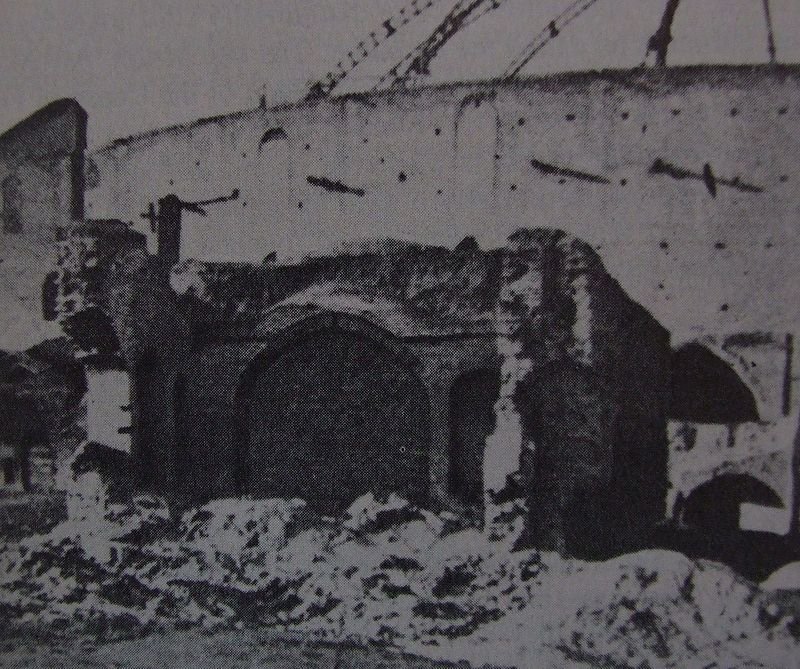
In 1868 the dungeon was filled in and an opera house was built over the site. The opera house was destroyed in 1947 and a bank building was constructed there. Baha’is acquired the property in 1954, but it was confiscated in the Islamic Revolution of 1979.
Bahá’u’lláh’s: Tablet of the Maiden (Lawh-i-Ḥúrí), was written in Baghdad. Following is an excerpt of the Tablet, translated by Juan Cole:
There arose the houri, Who had dwelt in pre-eternity in the pavilions of holiness, protection, and glorification and in the canopies of sinlessness, greatness and splendor. Upon Her creamy brow the most high pen hath written in crimson ink, “Praise be to God! This is a houri upon Whom none have gazed save God, the exalted, the most high. God hath purified the hem of Her purity from the knowledge of the concourse of names in the realm of eternity, and Her face from the view of all who are in the kingdom of creation. When She arose with the ornament of God from Her palace, She looked with one glance toward the sky. The people of the heavens swooned at the rays of Her visage and at the wafting of Her perfume. Then She looked with another glance toward the earth, and it was illumined by the lights of Her beauty and the loveliness of Her splendor.
Praise be to Thee, O my God, for all the wonders of Thy handiwork that Thou hast shown Me in Her, for the ensemble of Thy power, manifest in Her creation. She hung there, suspended. Then She journeyed through the sky as though striding across the horizon in mid-air. It is as though I discovered that the chain of being was set in motion by Her footfalls. She descended, drew nigh, and came until She halted before Me. I was bewildered by the subtleties and wonders of Her creation. Behold, I discovered within myself a passion that grew out of my yearning for Her. I raised my hands toward Her, and lifted the hem of Her veil from Her shoulder. I found Her hair to be sandy, wavy and curly, lying on Her back in ringlets, hanging down almost to Her legs. And when the gales blew it to the right of Her shoulder, it perfumed the heavens and the earth. When it was blown to the left, from its fragrance there spread a holy musk-like scent. It is as though the motion of Her tresses caused the spirit of life to quake in the inner essence of creation, and caused the kingdom of mystical insight to tremble in the realities of being.
I heard the gentle voice of my spirit guide say, “You won, Jera.” Hmmm what does that mean? We had just appealed a citation for $500. Will we get the money back? “You won, Jera.” She said it several times.
For three months we have not parked on our little lot. A week before my 71st birthday, we hung around for awhile, eating. A code enforcer stopped by and said the county could take our property away. He mentioned that several times. A week later, on my birthday, we received the $200 citation. For eating a meal on our own property? They called it illegal storage. Nothing was stored there. We got in our vehicles and drove away.
A week later we received a citation for $500. Early on a Sunday morning, the day before my birthday, i had gotten into the SUV and started the motor, my husband was opening the gate. Headlights were shining on him from a car parked on the dirt road across the street. I turned the motor off in order to turn my headlights off completely. Why doesn’t that car make its turn and make its way down the road?
Two months later i saw the photo. It came in a little booklet the county had put together about their case against us.
We paid the $700, asking to appeal both, but we had missed the 14-day deadline for the $200 one. Recently we received a letter cancelling the citation for $500 and granting the refund. What a surprise it was when we received a check for $800, everything we had paid in fines during the entire year!
When we overlook what we can do for our fellow travelers we are missing the whole point. Our faith is empty if we put concern for our own soul above the needs of another. (From a recovery day book)
Someone posted that on a group I’m in and i realized i was wrong to be annoyed when the person who laid his right arm on my left arm this morning until my shoulder ached turned off an interesting commentary in order to bore me with his fears. I could have told him—that he was internalizing a sci-fi fantasy that has no bearing on reality and could he please turn the program that his phone was playing back on because i wanted to hear it—without the annoyance in my voice. But that would have required remembering my meditation. How easy it is to forget!
I realized yesterday afternoon that i habitatualy bring the kundalini up from the first to the second chakra, a response i developed a long time ago to certain stimuli. Now, many years later, i am learning to bring it from the second to the third chakra.
I think someone must have intimidated me or reminded me of being intimidated, and my totally unconscious response was to bring the kundalini to my second chakra. That part is habitual. Then later when someone annoyed me i had to remember that i needed to bring the kundalini to the third chakra. I’ll get it habitual but it will take some practice.